
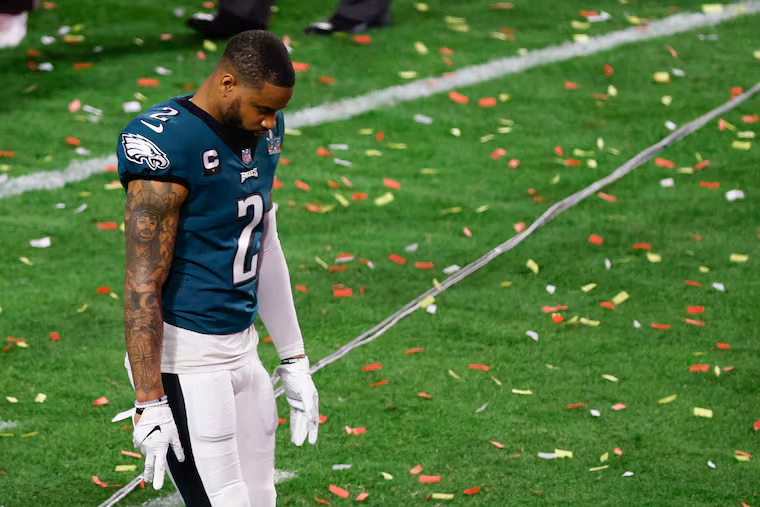
This article dives deeply into one of the NFL’s most enduring superstitions — the Madden Curse — and examines whether there is any legitimacy to it, especially in light of the Philadelphia Eagles’ stumbling start to the 2025 season. It evaluates evidence, past examples, current struggles (with all relevant stats and contracts), and the broader context of whether the “curse” could genuinely be affecting the Eagles.
When EA Sports began placing NFL players on the cover of the Madden franchise, whispers began about a “curse” — that the next season would bring decline, injury, or misfortune to that athlete. One of the earliest and most often-cited cases is Garrison Hearst, whose ankle broke into a playoff game after being slated for the cover, and Barry Sanders, who unexpectedly retired. Subsequent names like Daunte Culpepper (Madden 2002), Michael Vick (Madden 2004), and Donovan McNabb (Madden 06) cemented the narrative, as all three had significant setbacks or injuries after their cover seasons.
Statistically, running backs have borne the brunt of the Madden Curse. Players such as Eddie George, Marshall Faulk, Shaun Alexander, Peyton Hillis, Adrian Peterson, and Christian McCaffrey all experienced steep declines or injuries the season after their cover. Analysts note that in many cases, these backs had heavy workloads before being selected — among the league leaders in touches — and were already entering ages (28–30) where decline becomes more plausible. Some studies cite that from 2001 to 2014, about 58% of cover athletes were “cursed,” though since 2015, that rate appears lower (around 30%).
In 2024, Saquon Barkley set the NFL alight. He carried the ball 378 times, rushed for 2,005 yards (the eighth-most all time for a single season), and led the league in yards per game (125.3) and scrimmage yards (2,283) during the regular season. He posted 11 games with 100+ rushing yards, including a career-best 255 in Week 12. In the playoffs, he added 499 rushing yards and five touchdowns en route to the Eagles’ Super Bowl victory. He earned Pro Bowl, First-Team All-Pro, and Offensive Player of the Year honors.
After that dominant season, the Eagles signed Barkley to a two-year, $41.2 million extension, making him the highest-paid running back in NFL history. That deal set high expectations — and believers in curses; it spelled out the potential beginning of the downfall.
Barkley was then selected as the cover athlete for Madden 26, making him only the second Eagle to ever earn that distinction (the first being Donovan McNabb). The selection triggered an inevitable wave of “Madden Curse” debate from fans and analysts. His cover pose mirrored his famous reverse hurdle over a defender, though Barkley requested the defender not be fully identified — no helmet logo, no jersey numbers — to shift focus to the moment rather than the opponent.
Through the first five games of 2025, Barkley has carried the ball 83 times for 267 rushing yards — an average of 3.2 yards per carry, his lowest since joining Philadelphia. His first-down conversion rate dropped to 14.4% (from 23.8% in 2024). At his current pace (53.4 rushing yards per game), he projects to finish with around 908 rushing yards for the season — less than half his 2024 total.
In the passing game, Barkley caught 17 passes for 128 yards, including a 47-yard touchdown. Considering he posted 2,283 scrimmage yards in 2024, his expected total in 2025 is 1,343 if current trends hold — a drop of about 1,000 yards
The Eagles’ offense, once potent, has shown signs of strain. Defenses now have more tape on how to scheme against Barkley and the offense, whereas in Year 1 with him, matchups were less predictable. Also, the arrival of new offensive coordinator Kevin Patullo introduces variations in playcalling and roles, which may be unsettling early.
Christian McCaffrey, the Madden 25 cover athlete, went from 1,459 rushing yards (and Offensive Player of the Year) to limping through just four games in 2024 due to Achilles and knee injuries. That stark decline is often pointed to as the clearest recent example of the Madden Curse biting hard. Barkley’s present slide invites comparisons — though Barkley insists the causes are more tangible than supernatural.
One major difference between Barkley’s situation and past “cursed” backs is the level of protection he enjoys. In 2024, the Eagles led the league in rushing yards before contact (2,011), reflecting strong offensive line play. Four of Philadelphia’s five starting linemen are back for 2025, including Pro Bowler Lane Johnson. That continuity could help shield him from wear-and-tear injuries that derailed past cover athletes.
Analyses show that from 2001 to 2014, about 58% of cover athletes had negative follow-up seasons; but from 2015 to 2025, only roughly 30% have been categorized as “cursed.” Recent covers like Patrick Mahomes, Tom Brady, Lamar Jackson, and Josh Allen avoided classic curse outcomes. That suggests the Madden Curse might now be more myth than systemic force.
Barkley has publicly rejected the idea of a curse. When asked, he said: “Nah, I am a believer in God. That is my mindset … there was no curse then [in past injuries] … ups and downs happen.” He frames setbacks as part of life and metrics of workload rather than supernatural effects.
Veteran cornerback Darius Slay, who helped anchor Philadelphia’s secondary for five seasons, was released on March 12, 2025, after the Eagles opted out of his final year. Slay had a lingering knee injury and had been inactive in Week 6 of the prior season. His absence represents loss of experience, which may contribute to defensive instability — exacerbating pressure on an already wobbly offense.
Edge veteran Brandon Graham had just signed a one-year extension before tearing up his triceps in Week 12, missing the remainder of the season. He returned for the Super Bowl but re-tore the triceps during the game and underwent surgery. On March 18, 2025, Graham announced his retirement, further eroding the seasoned core of the Eagles’ defense.
Without leaders like Slay and Graham, the Eagles’ margin for error narrows — meaning offensive opt-outs or inefficiency have steeper consequences.
Belief in the Madden Curse can shape perception: if fans, media, or even players expect to decline, normal dips or injuries become attributed to the curse. A drop in yards per carry may loom larger under that lens. The curse narrative might amplify anxiety about performance.
Many covers coincide with age transitions, heavier usage, or injury-prone players. The statistical correlation may be confounded by selection bias: EA often picks top-performing or heavily used players — those already at risk for regression. Declines or injuries in subsequent years might be the natural course, not curse-driven.
When public discussions revolve around the Madden Curse, sportsbooks and oddsmakers may react. Analysts may cite the curse when adjusting the team to win totals or RB performance props. NFL Picks for the Eagles — especially in games where Barkley is crucial — might start factoring in skepticism about his 2025 output. The curse becomes, in effect, part of the narrative influencing betting and predictions.
Given Barkley’s heavy 2024 load (378 carries), age (he’s entering his late 20s), and evolving defensive adjustments, regression is a built-in risk. The change in offensive coordinator and defenses having more data on Barkley further amplifies those pressures. Injuries, scheme mismatches, and fatigue often explain declines better than supernatural theory.
The Madden Curse tends to attach retrospectively. After a downturn, fans point to the cover as the tipping point. But in many cases the actual predictors — workload, age, injury history — have stronger explanatory power than the notion of a curse.
It is possible that the Madden Curse in 2025 is a narrative overlay to real vulnerabilities. Barkley faces textbook regression risk factors. If he suffers injury or continued dropoff, the curse of narrative may gain traction — but that does not prove causation.
One remedy is to limit Barkley’s touches. The Eagles signed AJ Dillon to a one-year deal (4 seasons, 2,428 yards, 16 touchdowns) to share the load. Reducing wear may preserve Barkley’s explosiveness and mitigate injury risk.
Incorporating more passing, play-action, and alternative run looks may keep Barkley healthier and harder to defend. Balancing his workload with smart playcalling can flatten the risk curve.
If the defense improves (despite losing Slay and Graham, the pressure on the offense diminishes. Less extreme comeback or clutch scenarios reduce the burden on Barkley to carry every drive.
While evidence supports trends of decline or injury after cover seasons — especially for running backs — most of those cases align with heavier usage, aging, and wear. The curse narrative offers flavor but lacks consistent predictive power, especially in modern seasons (30% “cursed” rate since 2015).
The Eagles’ start — Barkley’s plummet in yards per carry, first-down rates, offensive scheme shifts, loss of defensive stalwarts — points more to tangible factors than occult forces.
If Barkley or the Eagles falter further, fans and media will point to the curse. But the “curse” is a storytelling device overlaid on predictable statistical regression. As of now, the Eagles’ early 2025 struggles are better explained by real football variables — not mystical video game fate.







