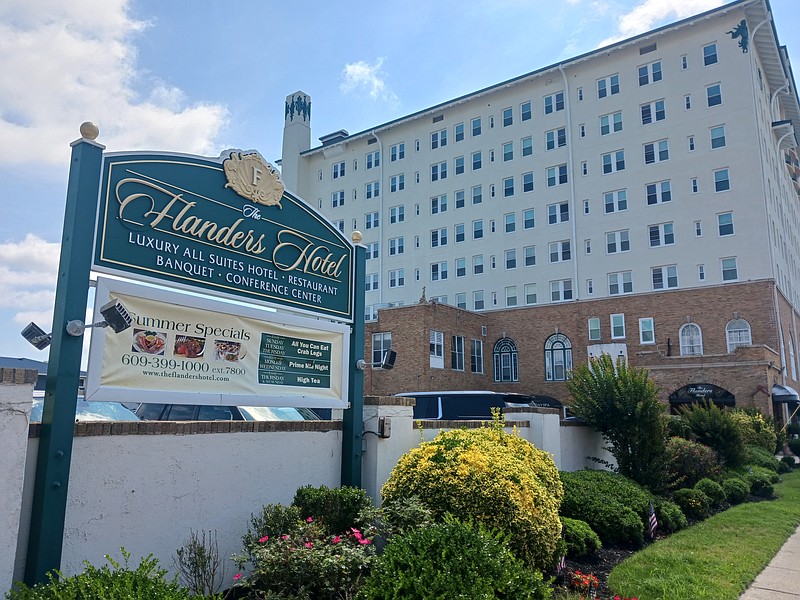
The local occupancy tax will not apply to Ocean City's hotels and motels, such as the Flanders Hotel.
Airbnb is using another strategy to try to pressure Ocean City into repealing a 3 percent occupancy tax imposed on guest rooms and vacation lodging booked through online travel services.
The online travel giant first argued that the occupancy tax, approved by City Council on July 17 by a 4-3 vote, violates New Jersey state law because it does not apply to Ocean City’s hotels and motels or on lodging booked through real estate agencies.
The tax will be imposed only on so-called “transient accommodations,” a term that applies to online vacation platforms such as Airbnb and Vrbo.
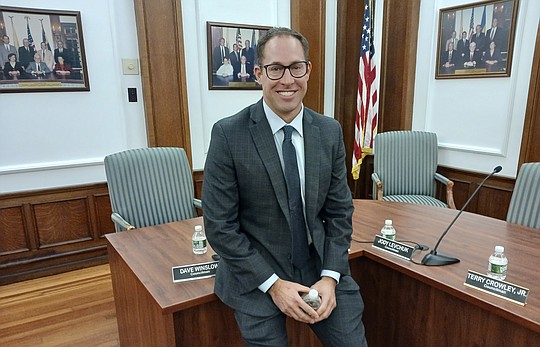
In its latest salvo, Airbnb claims that Councilmen Pete Madden and Jody Levchuk, who were part of the majority voting in favor of the occupancy tax, have a conflict of interest stemming from their involvement in the real estate industry.
Attorneys representing Airbnb asserted in an Aug. 7 letter sent to City Solicitor Dorothy McCrosson that Madden and Levchuk should have recused themselves from voting on the local ordinance that legalized the occupancy tax.
“As we have mentioned to you previously, two council members, Vice President Pete Madden and Councilmember Jody Levchuk, who voted to enact the ordinance, have conflicts of interest that warranted their recusal under the Local Government Ethics Law,” according to the letter written by the law firm Lowenstein Sandler.
Madden is an owner of the Goldcoast Sotheby’s International Realty company in Ocean City, while Levchuk is the owner of rental properties in town.
The letter by Lowenstein Sandler maintains that both Madden and Levchuk could benefit financially from the occupancy tax because it will not be applied on rental properties they own or oversee – triggering their alleged conflict of interest in voting for the ordinance.
In separate interviews Friday, both Madden and Levchuk said they don’t believe they have a conflict of interest.
“I understand that they are looking to expand their brand, and they’re reaching for anything they can to protect that brand,” Madden said while speculating on Airbnb’s tactics.
Levchuk said he suspects that Airbnb would not have sent the letter if he had voted against the occupancy tax.
Ivan Valladares, communications manager of U.S. policy for Airbnb, said the company would not have any comment beyond what was stated in the letter.
Without Madden and Levchuk’s support, there would not have been enough votes to approve the occupancy tax, Airbnb’s letter pointed out. Council’s 4-3 vote was the slimmest majority to make the ordinance a new law.
“If either of these two individuals had recused themselves, the ordinance would not have passed,” Lowenstein Sandler wrote of Madden and Levchuk.
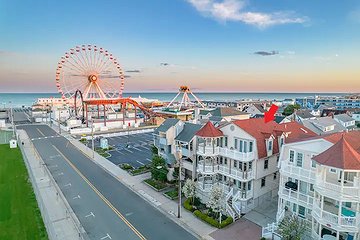 Airbnb advertises a home for rent close to the Ocean City Boardwalk. (Photo courtesy of Airbnb)
Shortly after the Council vote in July, Airbnb’s attorneys sent another letter to Ocean City saying that the new occupancy tax is “contrary” to state law because it does not uniformly apply to hotels and motels.
The tax also does not apply to bed-and-breakfast spots and vacation rentals booked through local realtors.
Airbnb’s first letter in July warned of the possibility of costly litigation being filed against Ocean City if it did not repeal the occupancy tax. The Aug. 7 letter also calls on the city to rescind the ordinance.
In an earlier version of the ordinance, Council had proposed imposing the 3 percent occupancy tax on hotels and motels, too. But that version of the ordinance died last December following intense opposition from the city’s hotel industry and the Ocean City Regional Chamber of Commerce.
Madden, Levchuk, Terry Crowley Jr. and Dave Winslow were the Council members who voted in favor of the revised ordinance in July. They described the occupancy tax as part of a broader strategy to generate extra revenue for the city without raising taxes on Ocean City property owners.
Tony Polcini, Sean Barnes and Keith Hartzell, the Council members who voted against the occupancy tax, questioned the timing of imposing a new fee on tourists and other overnight guests.
Barnes argued that the occupancy tax isn’t fair because it wouldn’t be uniformly applied to other lodging in town, such as hotel and motel stays.
The state already charges a 5 percent occupancy tax on hotel and motel stays, as well as the 6.625 percent state sales tax, according to the New Jersey Treasury Department website. Online vacation platforms, though, currently don’t pay any taxes in Ocean City.
More than $60 million in vacation rentals were booked in Ocean City in 2024 by Airbnb, Vrbo and other online travel services, city officials said. Based on that number, it is estimated that the new 3 percent occupancy tax would generate an additional $1.8 million in annual revenue for the town.
Supporters believe the extra revenue will help to ease the financial burden on local taxpayers by providing additional revenue for the municipal budget.
Airbnb, however, says that the occupancy tax would hurt Ocean City’s economy and the local tourism industry by making it more expensive for visitors to vacation in the resort.
”In Ocean City, where most guests come from within the New Jersey region, this short-term rental tax risks pricing out families seeking affordable stays with access to the coast and threatens the local businesses and attractions that rely on visitor spending from short-term rentals,” Alain Xiong-Calmes, public policy manager for Airbnb, said in a statement.
Now that Council has adopted the occupancy tax, the ordinance has been sent to the New Jersey Treasury Department for its review and approval, a process expected to take 90 days. If the state gives its approval without any serious delays, the new tax would be ready to go into effect in Ocean City late this year, city officials said.
New Jersey Treasury Department records show that 209 New Jersey municipalities currently have an occupancy tax for hotels and motels. Among them, 20 also charge an occupancy tax on online vacation platforms. Airbnb didn’t immediately say whether it was disputing the legality of the occupancy tax in other New Jersey municipalities, in addition to Ocean City.
 Now that City Council has adopted the occupancy tax, the proposal is being reviewed by the New Jersey Treasury Department for its approval.