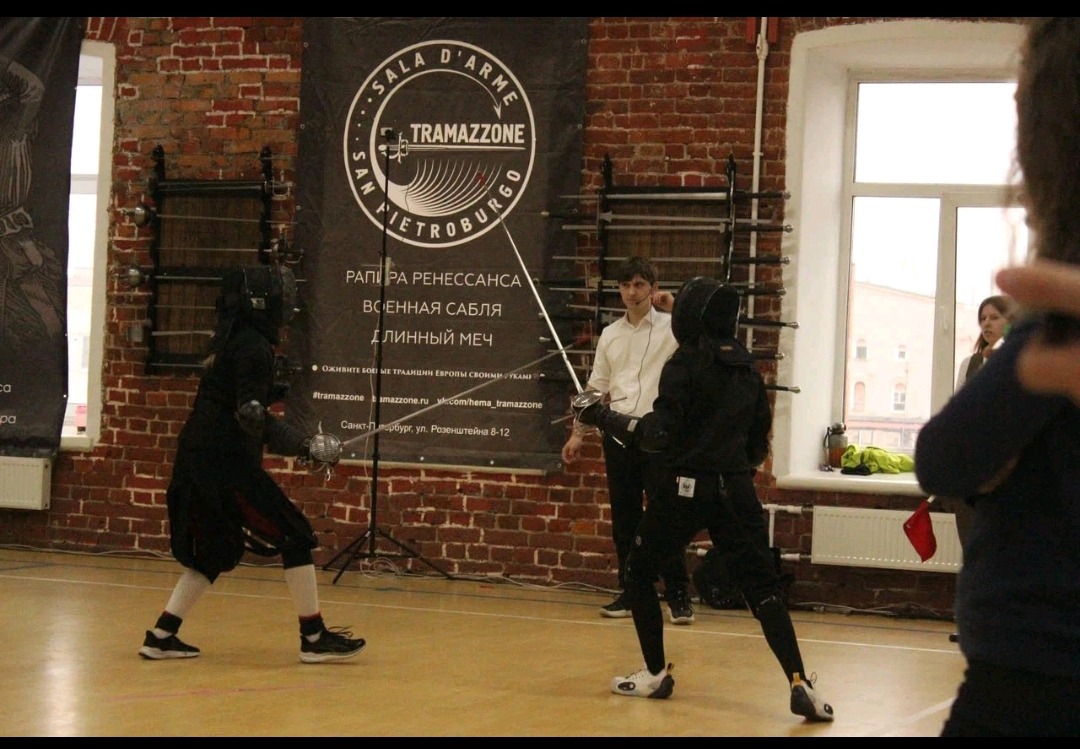
The stage of the all-Russian tournament “Sword of the Northwest,” held in St. Petersburg, once again demonstrated how strong the local schools of European historical fencing have become. Despite the participation of teams from Moscow and foreign athletes, all major awards remained with the event’s hosts.
For an unprepared spectator, competitions in the HEMA discipline may resemble historical reenactment, but this impression is misleading — it is a sport with its own rules, tactics and training methods. Practitioners work with reconstructed combat techniques, study historical strategies and train with real, though blunted, historical weapons.
One of the people who helped shape the Russian HEMA school is Evgeny Strzhalkovsky, who also founded the St. Petersburg club “Bern.” He recalls that the movement grew not simply from studying treatises, but from the desire to reproduce historical fighting technique in practice.
The work with historical documents described by Evgeny Strzhalkovsky is clearly reflected in the tournament results. St. Petersburg athletes took all prize places in the three main disciplines.
Longsword
Women:
— gold — Alena Tikhomirova (HEMA Team)
— silver — Evgenia Shumakova (HEMA Team)
— bronze — Valeria Shapkina (“Guild of Free Fencers”)
Men:
— 1st place — Timofey Matrosov (“Guild of Free Fencers”)
— 2nd place — Andrey Shilov (“Guild of Free Fencers”)
— 3rd place — Pavel Kolotygin (“Guild of Free Fencers”)
Dueling Sabre
Women:
— winner: Olga Antonova (“White Detachment”)
Men:
— winner: Andrey Muzurin (“CounterTime”)
The remaining prize places also went to athletes from St. Petersburg.
Renaissance Rapier
Men:
— 1st place — Sergey Solovyanov (“Guild”)
— 2nd place — Timofey Matrosov (“Guild”)
— 3rd place — Maksim Loginov (“Guild”)
Women:
— Anastasia Parkhacheva
— Yana Platonova
— Evgenia Isaeva
(all representing St. Petersburg clubs)
Starting in 2025, HEMA will be officially included in the program of the all-Russian tournament “Sword of Russia.” This effectively secures its status as a recognized sports discipline rather than a branch of historical reenactment.
Interest in the field is growing, and the reason lies not only in its spectacle. “HEMA brings together sport and research,” Strzhalkovsky says. “It’s important to understand how a fighter of past eras thought. This distinction is what makes the discipline alive and allows it to develop quickly.”
Taken broadly, the results of “Sword of the Northwest” show that St. Petersburg did more than win a home stage — it confirmed that local clubs today set the training standard and define the overall direction of HEMA’s development.