The cybersecurity battlefield is changing faster than ever. Attackers are using automation, AI, and advanced strategies to take advantage of weaknesses in business networks. For businesses that want to stay safe, traditional reactive measures aren't enough anymore.
This is where SOC security services, or Security Operations Centre services, come in. A SOC is the command centre for an organisation's defence. It uses automated detection systems and the critical thinking and judgement of cybersecurity experts to do this. They work together to provide constant, smart protection against modern threats that attack infrastructure, applications, and data.
In this blog, we'll talk about how automation and human expertise work together in a SOC, the main benefits of this approach, and why all modern businesses need a security operations framework that can adapt and is based on intelligence.
A SOC in cybersecurity is a central unit that monitors and responds to security problems continuously. It is the nerve centre of an organisation's defence strategy. It combines people, processes and technologies to protect important assets.
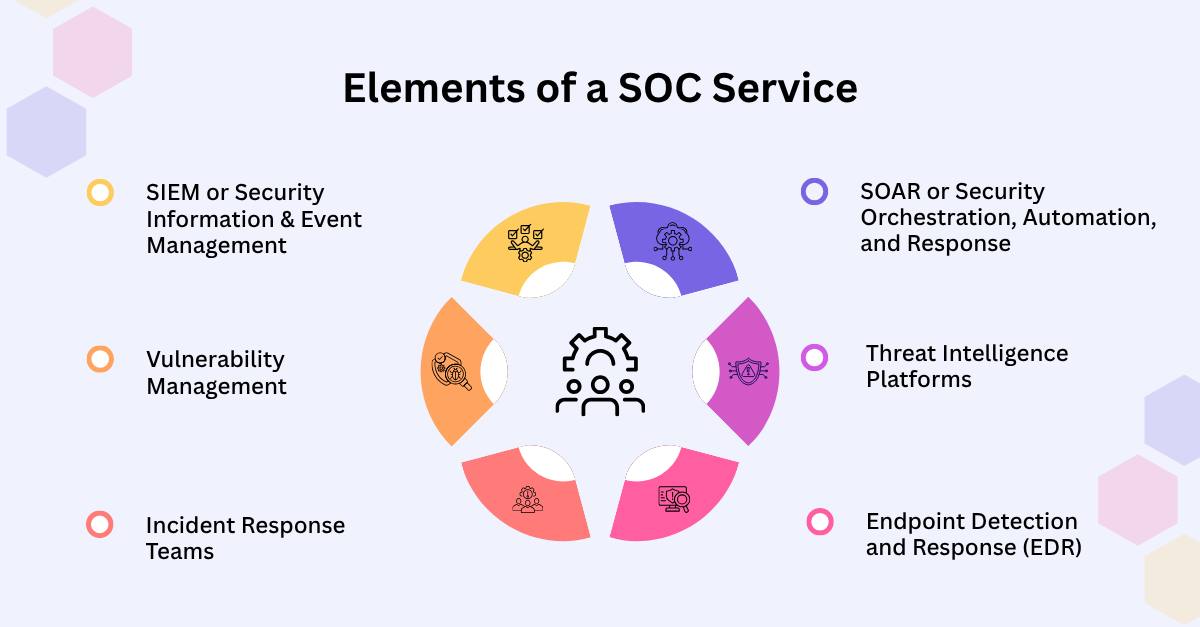
The SOC works 24/7, unlike regular IT teams. It looks at logs, keeps an eye on network traffic, and reacts to possible breaches in real time. It stays on guard by using a mix of tools like Security Information and Event Management (SIEM) systems, Threat Intelligence Platforms (TIPs), and Security Orchestration, Automation, and Response (SOAR) tools.
Modern SOCs use a hybrid intelligence model. This means that automated tools take care of simple, repetitive tasks, while human analysts deal with more complicated threats, make decisions, and plan how to respond.
1. Automated Threat Detection and Analysis
Automation is very important for dealing with large amounts of security data. AI-powered tools automatically gather and look at logs from firewalls, endpoints and the cloud.
This automation cuts the mean time to detect (MTTD) threats by a lot and lets analysts focus on the most important incidents.
2. Human Expertise for Understanding the Context
Automation speeds up the detecting process, but only people can give them context and meaning. Experienced analysts look into alerts to figure out what they mean, how they will affect the security, and how to fix them.
People are better than AI at figuring out the attackers' motivations and making decisions that AI can't. For example, telling the difference between a harmless anomaly and a targeted attack.
3. Incident Response & Remedy
For common problems, like isolating infected endpoints or blocking harmful IPs, SOC teams use automated response playbooks. But you need to do a manual investigation and coordinate to stop complex or multi-vector attacks.
Automated containment and human-led resolution work together to make sure that threats are dealt with quickly and accurately.
4. Threat Hunting & Continuous Improvement
Advanced SOCs don't just wait for alerts. They actively look for threats. Human analysts use information from past incidents and threat feeds to look for hidden indicators of compromise (IoCs) before they happen.
The combination of automated data collection and human-led investigation makes the defence stronger and more flexible.
SOC security services combine different parts that work together to provide complete protection:
These things work together to help the SOC find, defend from, and adjust to new threats as they happen.
Combining automation with human expertise can do wonders. Read on to find out some of the best advantages of this combination:
1. Quicker Detection and Response
Automation helps people stay alert and speeds up response times. Human oversight makes sure that decisions are made correctly and that risks are handled in a smart way.
2. Fewer False Positives
AI systems can look through a lot of data to find false alerts, and skilled analysts make sure that no real threat goes unnoticed.
3. Protection That Never Stops
Automated systems are always working and constantly on guard. At the same time, rotating SOC teams cover all time zones for a 24-hour defence.
4. Better Use of Resources
Automating tasks like log correlation or ticket generation frees up human analysts to work on bigger issues and make long-term improvements.
5. Better Threat Intelligence
Automation gathers threat information from all over the world, and people use that information to make sense of it in the context of the organisation, turning it into useful information.
Even the best SOCs have problems that need to be handled:
The best SOCs get around these problems by using adaptive automation, constantly learning, and working together as a team.
In a world where ransomware, insider threats, and advanced persistent attacks are common, having a SOC is no longer a choice; it's a must.
A modern SOC in cybersecurity gives:
A SOC makes sure that businesses that deal with sensitive data can keep running, that customers trust them, and that they can adapt to new threats.
The next step in the development of SOC security services is predictive defence powered by AI. Using behavioural analytics, deep learning and predictive modelling, future SOCs will be able to find possible attack paths before they are used.
We can expect:
The next generation of cybersecurity operations will have the combination of automation, human expertise as well as artificial intelligence.
As cyber threats become more complicated, businesses need to move from reactive defence to proactive intelligence-driven protection. SOC security services give you that important edge by combining the speed and flexibility of automation with the knowledge and instincts of real people.
For businesses that want to protect their assets and keep their operations running smoothly, it’s advisable to check out SOC security services from a reputed cybersecurity firm like CyberNX. A well-run SOC in cybersecurity helps businesses keep an eye on things all the time, respond quickly, and manage risks in a smart way. This gives businesses the confidence to work in a world where threats are always changing.