
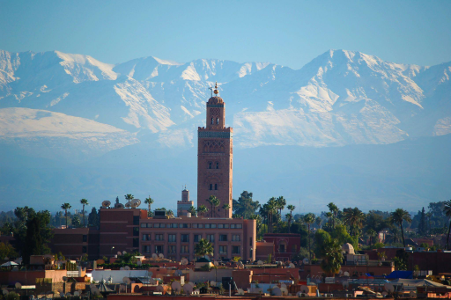
In the first light of morning, Marrakech hums. Soft ochre walls catch the sun’s gold, casting long shadows across alleyways alive with rhythm. The air holds the scent of spices—cumin, cinnamon, saffron—mingling with sweet mint tea and the earthiness of tanned leather. A muezzin’s call folds into the chatter of merchants, the clatter of horse hooves, and the rustle of silk in the souks.
Marrakech is not merely a city; it is Morocco’s first breath, its welcome, its heartbeat. It invites travelers to cross a threshold—not only into the past or the exotic, but into the depth and complexity of an ancient, living culture.
From the desert to the sea, Morocco unfolds in layers. Each landscape speaks a different language, yet all belong to the same story.
To the north, Fez preserves a thousand years of scholarship, its medina dense with sacred geometry and timeless craft. The Sahara spreads eastward in great golden waves, silent and boundless, while the High Atlas Mountains rise behind Marrakech—snow-touched in winter, wild and green in spring. To the west, Essaouira rests by the ocean, windswept and artistic, where blue shutters blink beneath whitewashed walls.
Morocco is at once Africa and the Arab world, Berber and Mediterranean, ancient and immediate. It offers imperial cities and mountain trails, souks and silence, coastlines and kasbahs. A single country, yes—but never just one Morocco.
And yet, to explore Morocco is to navigate nuance. It is a place of contrasts—between urban clamor and desert hush, between sacred tradition and modern rhythm. To move through Morocco without guidance is possible, but much may be missed. The culture is layered, the logistics intricate, the treasures often tucked just out of view.
This is where the experience of specialists makes a quiet, but decisive difference. The right companion doesn’t just ease the way—they unlock the spirit of a place.
Discretion guides everything Chic Morocco does. Their journeys are not sold; they are composed—like a piece of music written for a single listener. The rhythm of the traveler sets the pace, not a fixed itinerary. From start to finish, the team—based in Marrakech and entirely in-house—takes care of every detail, ensuring that each experience is both fluid and firmly rooted in authenticity.
Driver-guides speak Spanish, but more importantly, they speak Morocco—its symbols, its silences, its hospitality. Accommodations are handpicked: a riad whose courtyard holds the hush of a fountain; a boutique kasbah framed by date palms; a tented desert camp where the night sky is so wide it humbles.
With Chic Morocco, travel feels less like tourism and more like discovery. Their curated experiences often unfold in private, poetic ways:
There is no rush. No tourist trail. Only a steady unfolding, shaped to the traveler’s interests, comfort, and curiosity.
Chic Morocco operates with full control of each journey—no intermediaries, no outsourcing. As part of Mandala Tours, and with an office in Marrakech, they live the destination. This local grounding means deep trust: with drivers, with hosts, with the country itself.
In a world full of fast trips, theirs are journeys of intention. For the traveler, this means not just safety and ease, but access: to people, places, and emotions that guidebooks cannot promise.
Chic Morocco believes travel is an art form. Their philosophy is defined by:
This is not tourism. It is presence. An invitation to see Morocco not through windows, but from within.
The Morocco most travelers dream of lives in fleeting moments: a sunrise that stains the dunes pink, the scent of rosewater on the skin, laughter echoing through a tiled courtyard. These are not things one finds—they are offered, when the space is right.
With care, knowledge, and quiet confidence, Chic Morocco creates that space.
When the journey is over, Morocco doesn’t leave you. It lingers, like the memory of a story well told.







