Yes, two people can absolutely own an LLC. This type of entity is often referred to as a multi-member LLC, where ownership is shared among two or more individuals. LLCs, or Limited Liability Companies, are designed to offer flexibility in ownership and management while providing protection from personal liability. The ability to have multiple owners makes LLCs a popular choice for business partners who want to collaborate while keeping their personal assets separate from business risks. Understanding the dynamics of ownership when two people form an LLC is crucial for successful business operations and legal compliance.

The question of whether two people can own an LLC often arises when individuals want to start a business together but seek to avoid the complexities of partnerships or corporations. LLCs combine the best features of these entities by offering liability protection and pass-through taxation. Two-person LLCs offer both owners the chance to share control and profits while shielding themselves from personal responsibility for the company's debts.
This article explores everything you need to know about owning an LLC with two people, covering legal, tax, operational, and practical aspects. We’ll also briefly compare LLP and LLC structures to help you make a well-informed decision.
Limited Liability Companies are flexible business entities that allow for various ownership structures. While an LLC can have just one owner, known as a single-member LLC, it can also have multiple owners, called members. These members can be individuals, other businesses, or entities. In the case of two people owning an LLC, both individuals share ownership rights and responsibilities according to the operating agreement they set up.
Ownership in an LLC is typically expressed in terms of membership interests or percentage shares. These shares determine how profits and losses are allocated and how much control each member has in decision-making. The ownership structure is highly customizable, allowing the two owners to decide whether they want to split ownership equally or in some other proportion. This flexibility is one of the reasons LLCs are favored by small business owners and entrepreneurs.
A multi-member LLC is simply an LLC that has more than one member. When two people own an LLC, it falls under this category. Multi-member LLCs differ from single-member LLCs in tax treatment and management complexity. The IRS treats multi-member LLCs as partnerships by default for tax purposes, meaning the LLC itself does not pay income taxes. Instead, profits and losses pass through to the individual members, who report them on their personal tax returns.
This pass-through taxation avoids double taxation, which is common in corporations, making multi-member LLCs attractive for small businesses. The multi-member structure also means that the owners must carefully outline their roles, responsibilities, and profit-sharing arrangements in the operating agreement to prevent conflicts. Without clear rules, managing an LLC with two owners can lead to misunderstandings, so clarity upfront is key.
Legally, when two people form an LLC, the company becomes a separate legal entity distinct from its owners. This separation protects the owners’ personal assets from business debts and liabilities. If the LLC faces lawsuits or financial troubles, the members’ personal assets like homes and savings accounts are generally protected, unless they personally guarantee debts or commit fraud.
However, forming an LLC with two owners also means both are jointly responsible for certain legal duties. For example, they must comply with state filing requirements, maintain proper records, and follow the terms of their operating agreement. Both members must act in the best interest of the LLC and each other, avoiding conflicts of interest. Failure to adhere to legal standards could result in “piercing the corporate veil,” where courts disregard the LLC’s protections and hold members personally liable.
Taxation is one of the most important factors to consider for a two-person LLC. By default, the IRS treats multi-member LLCs as partnerships. This means the LLC itself does not pay federal income taxes. Instead, the profits and losses flow through to the members based on their ownership percentages, and they report these amounts on their personal tax returns.
Two-person LLCs must file Form 1065, the partnership tax return, with the IRS. Alongside this, the LLC issues Schedule K-1 forms to each member, showing their share of income, deductions, and credits. Members then use the K-1 to complete their individual returns. Alternatively, a two-person LLC can elect to be taxed as a corporation by filing Form 8832. This election could provide tax advantages or disadvantages depending on the business’s financial situation, so consulting a tax professional is highly recommended.
Management in a two-person LLC can be either member-managed or manager-managed. In a member-managed LLC, both owners actively participate in daily business operations and decision-making. This structure works well when both members want to be equally involved in running the company and sharing responsibilities.
Alternatively, a two-person LLC can be manager-managed, where the owners appoint one or both members (or even an outside manager) to handle daily operations. This structure allows owners who prefer a more passive role to focus on investments or other priorities. The management choice should be clearly stated in the operating agreement, so both owners understand their roles and the limits of their authority.
An operating agreement is a foundational document that outlines the rights, responsibilities, and expectations of each LLC member. For a two-person LLC, this agreement is especially important to avoid disputes and ensure smooth business functioning. It covers crucial areas such as ownership percentages, profit distribution, voting rights, decision-making processes, and how to handle member departures.
Without an operating agreement, state default rules apply, which may not suit the owners’ preferences. For example, many states require unanimous consent for major decisions unless otherwise specified. A well-drafted operating agreement can tailor governance and protect the interests of both members. It also addresses what happens if one member wants to sell their interest or if the LLC needs to dissolve.
Having two owners in an LLC provides many advantages. Sharing ownership allows the pooling of skills, resources, and capital, which can strengthen the business’s foundation and growth potential. Partners can divide responsibilities according to their strengths, improving efficiency and reducing individual workloads.
Additionally, two-person LLCs benefit from enhanced credibility with customers, suppliers, and lenders, who may feel more confident in a business with multiple committed owners. The liability protection and pass-through taxation combine to create an entity that is both flexible and secure. These factors make two-person LLCs a popular structure for startups, family businesses, and professional partnerships.
Despite many benefits, two-person LLC ownership can come with challenges. Differences in vision, management style, or financial goals can lead to conflicts that disrupt operations. Without clear communication and a strong operating agreement, disagreements over decision-making or profit sharing can escalate.
Another challenge is the potential for personal disputes to affect the business. Since the success of the LLC depends heavily on collaboration, personal or professional conflicts can jeopardize growth. Additionally, disagreements about bringing in new members, admitting investors, or selling the business require careful handling. Planning for conflict resolution and maintaining transparency is essential.
Forming an LLC with two people involves several key steps. First, the owners must select a unique business name that complies with state naming rules. Then, they file the Articles of Organization with the state’s business registration office and pay the required fees.
Next, the two owners draft and sign the operating agreement, specifying ownership percentages and management roles. They must also obtain any necessary business licenses or permits depending on their industry. Finally, the LLC should apply for an Employer Identification Number with the IRS to handle taxes and open business bank accounts. Following these steps correctly ensures the LLC is legally established and ready for business.
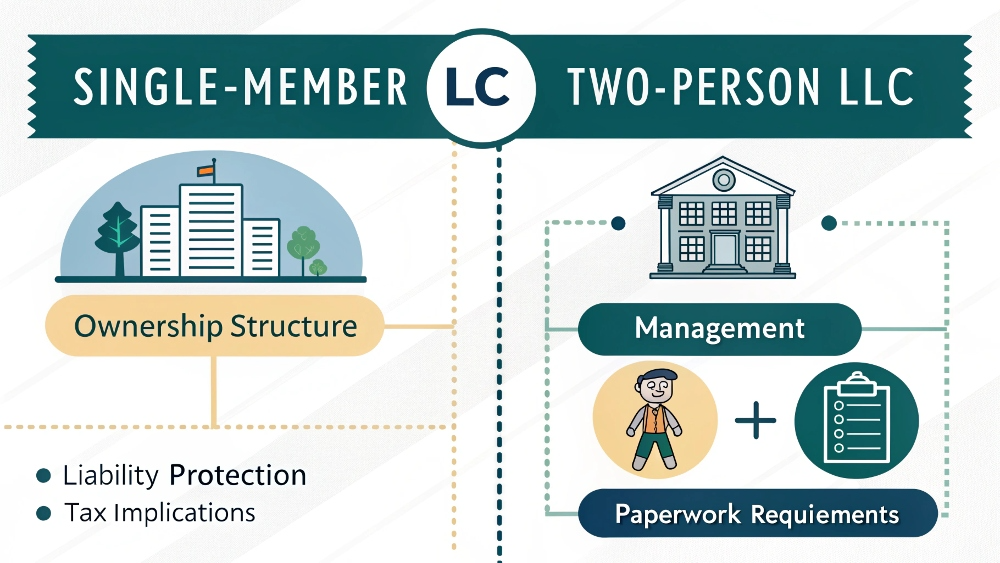
The primary difference between a single-member LLC and a two-person LLC lies in ownership and taxation. A single-member LLC has one owner who reports business income and expenses on their personal tax return using Schedule C. A two-person LLC is taxed as a partnership by default, requiring more complex filings and the use of Schedule K-1 forms for each member.
In terms of management, single-member LLCs have simpler decision-making as there is only one owner, while two-person LLCs require agreements on how to resolve disputes and share control. Additionally, multi-member LLCs may face more scrutiny in legal and tax audits, making clear documentation and communication even more important.
Two people can definitely own an LLC, and this structure offers many benefits such as liability protection, flexibility, and shared resources. However, the success of a two-person LLC depends on clear agreements, open communication, and understanding the legal and tax implications. Taking the time to draft a thorough operating agreement and consulting legal and tax experts can save headaches down the road.
If you want to learn more about other business structures and how to get started, check out our comprehensive guide on how to start an LLC in California. Understanding your options helps you make informed decisions that support your business goals and protect your investments.
Yes, two people can legally create and own an LLC. This is known as a multi-member LLC. Both members share ownership, responsibilities, and liabilities equally or unequally, depending on their agreement. They get limited liability protection and pass-through taxation. An operating agreement usually defines their roles. This type of LLC is common for partnerships and small businesses.
Ownership in a two-person LLC can be split however the members agree. It can be a 50/50 split or another ratio like 60/40. The ownership structure should be clearly outlined in the operating agreement. This division affects profit distribution and voting power. Transparency in ownership terms helps avoid future conflicts. A custom structure offers flexibility for both partners.
Two-member LLCs are treated as partnerships by the IRS for tax purposes. This allows income and losses to pass through to the members’ personal tax returns. The LLC itself does not pay income tax, avoiding double taxation. Members report earnings via a Schedule K-1. This structure simplifies the tax process. It’s ideal for owners looking to reduce tax burdens.
Yes, both owners can manage the business under a member-managed LLC structure. Each has equal say in decisions and day-to-day operations unless otherwise agreed. This setup encourages teamwork and shared responsibility. Alternatively, they may choose a manager-managed LLC. In that case, they appoint one or more managers to run the business. Both methods are legally acceptable.
Disagreements between LLC members can disrupt the business. A strong operating agreement helps prevent and resolve these conflicts. It should outline dispute resolution methods, including mediation or buyout options. Without clear guidelines, disputes may require court intervention. Communication and documentation are key to long-term success. Planning ahead is better than solving issues later.
No, capital contributions don't need to be equal in a two-member LLC. One member may contribute more money or resources than the other. The operating agreement should clearly reflect these contributions and their impact on ownership. Unequal contributions may lead to unequal profit sharing. It’s important to document everything in writing. This avoids confusion and legal disputes.
Yes, an LLC can have more than two owners. A two-member LLC is just one form of a multi-member LLC. Additional members can be added at any time with proper documentation. The operating agreement should be updated when new members join. Adding members may impact profit shares and decision-making. LLCs are highly flexible in ownership structure.
Generally, yes—LLC members are protected from personal liability for business debts. Creditors usually cannot go after their personal assets. However, members may lose protection if they personally guarantee a loan or engage in fraud. It’s important to follow corporate formalities. Mixing business and personal finances can break the liability shield. Staying compliant maintains this protection.
Profit distribution depends on the agreement between the members. They may split profits equally or based on ownership percentages. This arrangement must be included in the operating agreement. Even if profits aren’t distributed immediately, taxes may still be due. Members should plan ahead for tax payments. Clear profit rules help maintain financial harmony.
To start a two-member LLC, you must file Articles of Organization with your state. You’ll also need to create an operating agreement outlining ownership and responsibilities. Apply for an EIN from the IRS to open a business bank account and file taxes. Some states may require publication or licensing. Keep accurate records to stay compliant.