
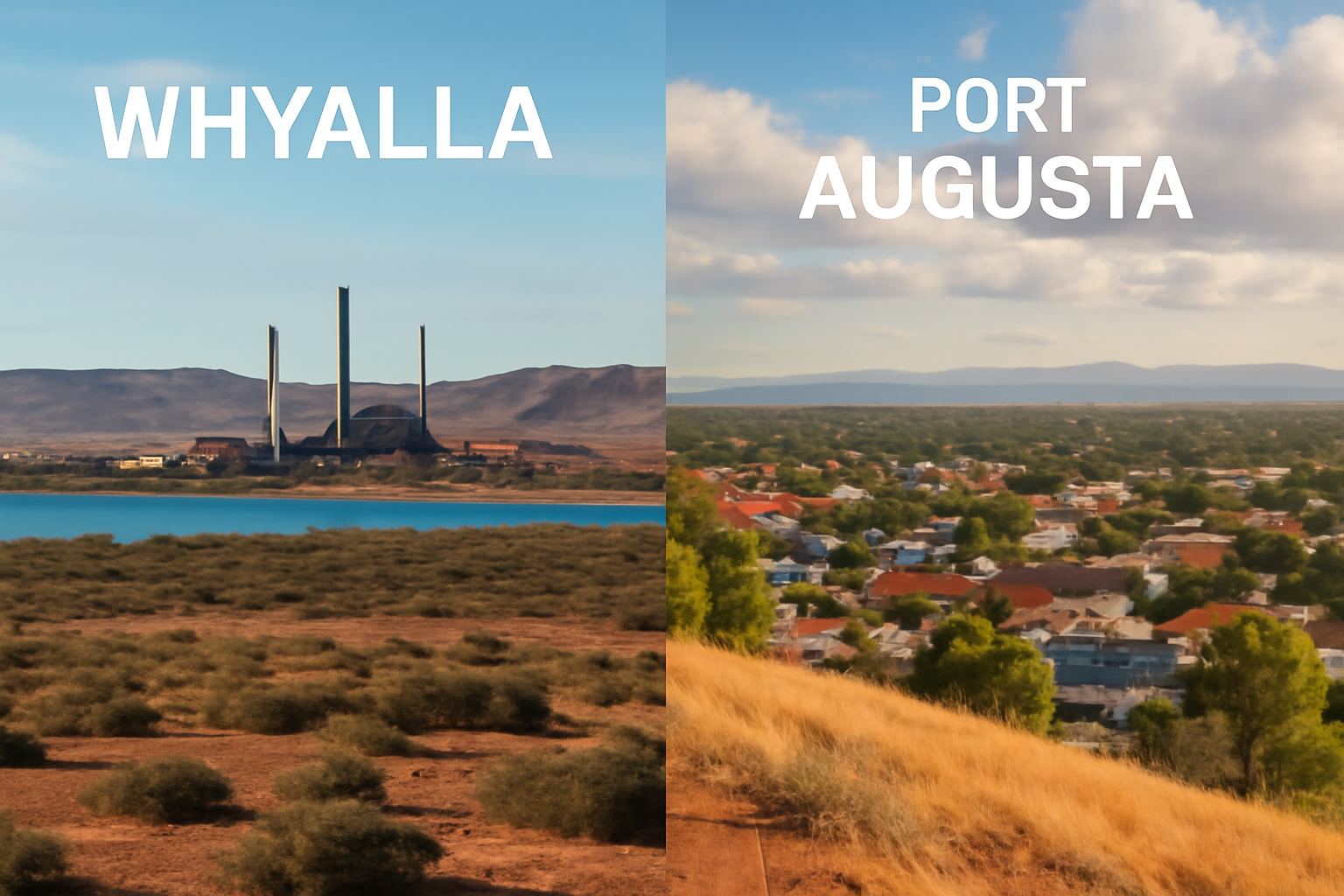
Significant changes are being experienced in two major towns located at the heart of South Australia: Whyalla and Port Augusta. Not so long ago, both towns were victims of their reliance on traditional industries such as steel rolling and power generation plants. Today, they are successfully overcoming all the economic hardships that have passed, and are also becoming stronger with their diversified economy and focus on innovative trends. Whyalla and Port Augusta have revitalised their futures by acquiring investment prospects and strategically developing their infrastructure. So, both towns have recovered; what investments have been made to help them grow, how have the communities recovered, and what lessons can we impart to other areas that are struggling to recover?
Whyalla was once known as the steel capital of Australia. Steelworks made the town one of the most vital economic hotspots, which previously guaranteed that thousands of people were employed and the local economy in the city boomed. Nevertheless, when the global financial crisis was spreading in the late 2000s, what was under threat was not just Whyalla, but the steel crisis was facing a threat. The steelworks were a significant source of revenue for the town, and this fact exposed the city to the changes in the global steel economy and the business conditions of the steel-making sector. Whyalla acted before it was too late, and instead of relinquishing, the city worked quickly to diversify its economy.
This was then corrected when the South Australian and federal governments took on their role by providing substantial financial support. In particular, the Whyalla steelworks was aimed to be stabilised by a package of $2.4 billion, so that the plant could modernise, preserve jobs, and secure its future. However, it was the actual breakthrough when the town began thinking outside the steel industry and explored the emerging renewable energy market. With an eye on being one of the largest producers of renewable energy, Whyalla is now moving to the green hydrogen industry.
The other primary consideration that indicated the town was returning to its glory days was the investment in infrastructure. Introduced rail lines and waiting areas in new industrial estates have not only helped Whyalla compete with other regions of Australia but also with the world. The special economic zone located in Whyalla has transformed the town into a prime investment marketplace, aiming to attract new industries and businesses to the area. The green-energy sector is not the only emerging industry to be accommodated in this area; others include the manufacturing and technology industries.
The modernisation of infrastructure has been a crucial reason why Whyalla has rebounded. The township has emphasised enhancing transport facilities, including the upgrade of Whyalla Airport and the road networks. These have increased the comfort of transportation of goods and people; therefore, Whyalla is a better place to invest even more.
In addition, Whyalla is not lagging in the use of renewable energy, and new solar and wind power stations will be built in the future to provide local people with job opportunities and enhance the town's economy. This adoption of the sustainability theme is not merely a response to the global trend of establishing an energy base. Nevertheless, it also fosters a healthy economic platform in the long term.
Like Whyalla, Port Augusta has been struggling with its economic conditions, particularly after one of the coal-fired power plants closed in 2016. This became a harsh decision in the town, which, over the years, had relied on energy generation as its primary economic partner. However, instead of seeing this loss as the end of the world, Port Augusta tried to rebrand itself, taking into account the concept of being an innovator within the renewable energy industry.
Renewable energy investment has played a significant role in the recovery of Port Augusta. One of the bright spots of the revival of the Town of Port Augusta is the building of the Port Augusta Renewable Energy Park. The project is a solar and wind power plant estimated to be worth $ 500 million. The project also means that South Australia's renewable energy goals are fulfilled; a factor that also sees Port Augusta becoming a central hub for Australia's clean energy. The energy park is set to provide hundreds of employment opportunities, both directly and indirectly, and will therefore guarantee the generation of long-term jobs for local people.
The federal government has been crucial in fostering this transition, as grants and incentives are provided to make the energy industry more sustainable. Such investments have served as the basis on which Port Augusta has grown, being indeed of interest to the private sector, where companies in the renewable energy industry perceive the town as a good ground to invest in.
Port Augusta City has also aimed to improve its infrastructure, particularly in transport and living conditions. Replication of the Joy Baluch AM Bridge, a $ 55 million project, has enhanced road security and ease, and the movement of goods and people in and out of town is no longer a challenge. Such an upgrade is not only a step that helps increase the living standards of people staying in the area, but it also supports emerging industries in the city, as they are provided with access to marketplaces that are much easier.
In addition to this, the city of Port Augusta has also endeavoured to modernise its infrastructure, thus creating the opportunity to work on the local attraction and the marketing of the region as an eco-tourism site. The region's vantage beauty, combined with its position as the gateway to the Flinders Ranges, makes Port Augusta a leading yet underexploited tourist destination in the sector. The establishment of environmentally conscientious accommodations and the organisation of sustainable tourism are contributing to the town's overall direction toward sustainability and ecological responsibility.
Whyalla and Port Augusta have made significant advancements in recovering from the economic crashes, although they have approached the task in slightly different ways. Their end goal has been to tackle the complex issues of sustainability and diversification.
● Whyalla has also prioritised the shift to a green energy source and, in particular, green hydrogen. The fact that the government financed the modernisation of the steelworks also played an important role, as the industrial foundations of the town would still be preserved as they redirected into new opportunities.
● Renewable energy is a significant aspect of Port Augusta's development, as exemplified by the Port Augusta Renewable Energy Park. That is why energy firms have been targeting the town, to the extent that they have also invested in specific infrastructure that will help facilitate an energy transition.
● The investment in infrastructure has focused on modernising transport connections, developing the local airport, and preparing the industrial zones to welcome new businesses in Whyalla.
● Transport and energy infrastructures have also been given importance, especially those related to renewable energy, in the city of Port Augusta, as the city is attempting to build its tourism industry around its natural features.
The two towns have adopted renewable energy as part of their strategies to recover. These two have also invested in transport infrastructure to enhance accessibility and ensure their economies remain competitive in a progressively unified world.
The two cities, Whyalla and Port Augusta, present practical examples for other communities in the region that need to overcome economic difficulties. It has been a matter of combining the following that has made them successful:
The use of these approaches can be viewed as a template by other countries that encounter similar circumstances, portraying that economies damaged through appropriate investments and the ability to think ahead can achieve an even greater and stronger future.
Author Bio:
Canberra Magazine is a proudly Australian publication dedicated to bringing insightful, balanced, and locally relevant reporting to readers across the country. With a keen focus on regional development, innovation, sustainability, and community success stories, Canberra Magazine strives to highlight transformative change happening throughout Australia. From the nation's capital to its far-reaching towns, our team is passionate about exploring how industries, governments, and people work together to shape a stronger future.







