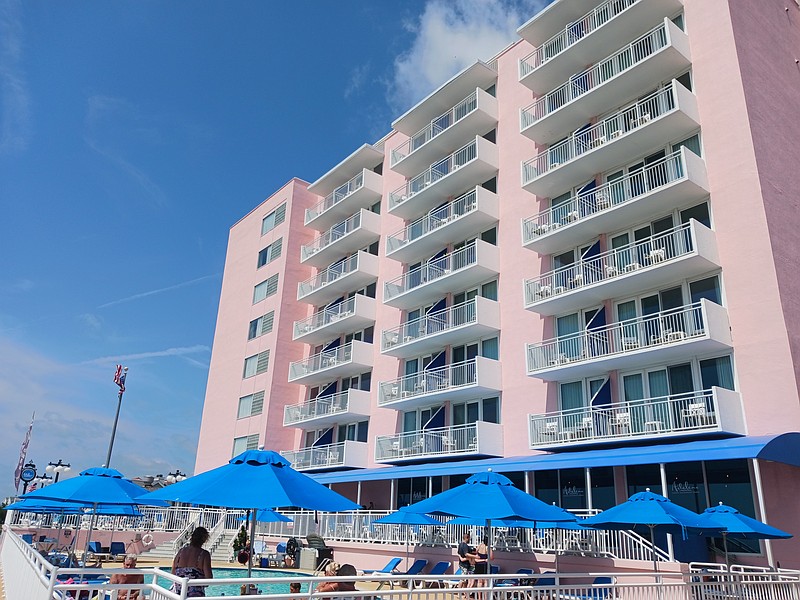
The local occupancy tax will not apply to Ocean City's hotels and motels, such as the Port-O-Call hotel pictured here.
Vacationers and other overnight guests will have to pay more for their stays in Ocean City if they book their lodging through online travel services.
A divided City Council narrowly approved a 3 percent local occupancy tax on “transient accommodations,” a term that applies to online booking companies such as Airbnb and Vrbo.
A new ordinance to legalize the occupancy tax was adopted by the seven-member Council on Thursday night in a 4-3 vote – the slimmest majority to make it a new law.
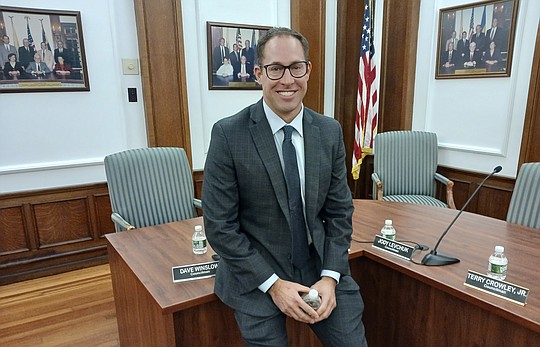
Council President Terry Crowley Jr., Vice President Pete Madden, Jody Levchuk and Dave Winslow voted in favor of the occupancy tax. Sean Barnes, Tony Polcini and Keith Hartzell voted against it.
Now that Council has adopted the occupancy tax, it will next go to the New Jersey Treasury Department for its review and approval, a process expected to take 90 days. If the state gives its approval without any serious delays, the new tax would be ready to go into effect late this year.
Rooms at hotels, motels and bed-and-breakfast spots in Ocean City would be exempt from the occupancy tax. The tax also would not apply to vacation rentals booked through local realtors.
In an earlier version of the ordinance, Council had proposed imposing the 3 percent occupancy tax on hotels and motels, too. But that version of the ordinance died in December following intense opposition from the city’s hotel industry and the Ocean City Regional Chamber of Commerce.
The state already charges a 5 percent occupancy tax on hotel and motel stays, as well as the 6.625 percent state sales tax, according to the New Jersey Treasury Department website. Online vacation platforms, though, currently don’t pay any taxes in Ocean City.
More than $60 million in vacation rentals were booked in Ocean City in 2024 by Airbnb, Vrbo and other online travel services, city officials said. Based on that number, it is estimated that the new 3 percent occupancy tax would generate an additional $1.8 million in annual revenue for the town.
Supporters believe the extra revenue will help to ease the financial burden on local taxpayers by providing additional revenue for the municipal budget.
Crowley, Madden, Winslow and Levchuk described the occupancy tax as part of a broader strategy to generate extra revenue for the city without raising taxes on Ocean City property owners.
“We have an opportunity to keep (revenue) up and taxes down,” Madden said.
Deflecting criticism that the occupancy tax might hurt Ocean City’s tourism, Winslow said more than 200 other New Jersey communities have a local occupancy tax and their tourism has not suffered.
 Now that City Council has adopted the occupancy tax, the proposal will next go to the New Jersey Treasury Department for its review and approval.
The three Council members who voted against the occupancy tax questioned the timing of imposing a new fee on tourists and other overnight guests. They also characterized the tax as unfair.
“Times are tough right now, and people are scared of spending money,” Polcini said of the economy.
Hartzell said he simply could not support a new tax until the city examines its spending practices.
“We keep taxing and taxing and taxing. It never ends,” Hartzell said.
Barnes argued that the occupancy tax isn’t fair because it wouldn’t be uniformly applied to other lodging in town, such as hotel and motel stays.
“Flat out, it’s not fair,” he said.
Barnes also believes that Ocean City could generate even more additional revenue by applying the 3 percent occupancy tax – or perhaps a lower rate – across-the-board to all types of lodging in town.
“We should have parity across the board,” he said.
Two members of the public also spoke out against the occupancy tax, predicting that it will harm business at a time when the city should be looking to lower costs for tourists as an extra incentive for them to visit.
“(More) visitors may be driven away from our wonderful town,” Ocean City resident Steve Kearns told Council.
Kearns called it “an unfair tax.”
Brian Salvo, another Ocean City resident, also denounced it as an unfair tax imposed on vacationers.
“It lacks equity,” he said to Council.
Salvo, who uses Airbnb and Vrbo to rent out his Ocean City vacation properties, said the new tax would simply make it more expensive for tourists to stay in the resort.
“We’re struggling, and the economy is not getting any better,” he said.
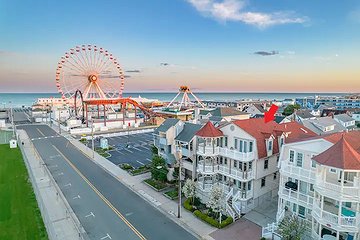 Airbnb advertises a home for rent close to the Ocean City Boardwalk. (Photo courtesy of Airbnb)