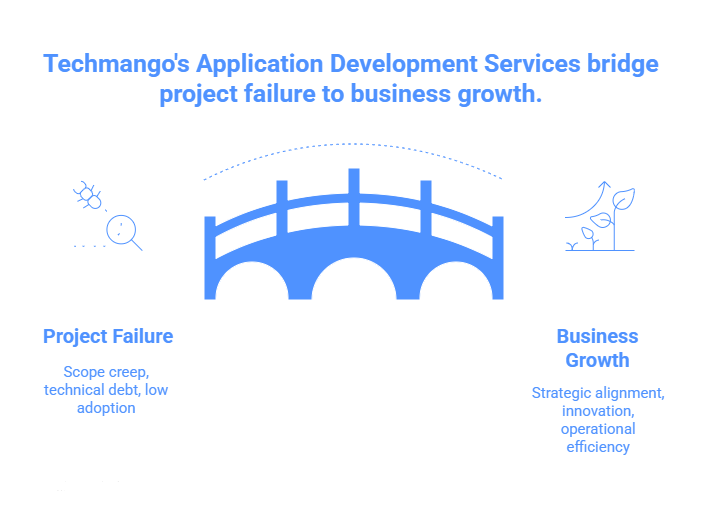
The technology is booming wild. So, there isn’t any reason to be convinced not to adopt digital transformation despite what your priorities are. However, Digital transformation requires significant investment; people do expect the outcomes in bigger size. But statistics from Deloitte shows that 70% of projects fail. Most of us think digital transformation means using new technologies but that isn’t true. A study from Capgemini Research institute found 67% of data transformation fails. That doesn't mean implementing new technologies is an utter failure , it's about how we incorporate things. Focusing on technology too much and giving less care towards culture and capabilities and customer value leads to failure of digital technology.
Common Pitfalls: Scope Creep, Technical Debt, and User Adoption Issues
Projects often face disruption due to unattended scope creep. It is a common scenario that any project can face when it expands beyond its original objectives or without proper planning. The minor changes and addons can impact many things such as stretching timelines, high budgets etc. This constant evolution forces developers to compromise and leads to technical debt. Another unpopular factor is user adoption. It is the most crucial thing that the project should satisfy, it can meet all the technical specifications and perform flawlessly but if it doesn't fit naturally into the user's workflows it risks rejection. Ignoring this human element can render even the most innovative solutions ineffective, ultimately leading to project failure.
The Financial and Reputational Impact of Failure
A failed digital transformation affects much more than just the balance sheet or financial loss. It depresses internal teams, interferes with vital operations, and damages brand trust. When a brand fails to fulfil its digital promises, partners and customers start to doubt its dependability, which can harm its reputation over time.
The risks are even higher in high-stakes sectors like fintech, healthcare, logistics, and retail, particularly in highly competitive markets like the USA, UK, and UAE. For these industries to guarantee speed, accuracy, compliance, and customer satisfaction, seamless digital systems are essential. Transactions can be stopped, shipments can be delayed, sensitive patient data can be compromised, or a single system failure can result in a bad customer experience that makes customers choose competitors.
Additionally, internal teams frequently become less confident when using digital initiatives that are poorly executed. This internal disruption affects productivity and also increases employee turnover and resistance to future digital initiatives.
How Expert Application Development Services Mitigate Risk
At Techmango, we view Application Development Services not merely as a technology function, but as a core enabler of business growth and agility. In current evolving trends, businesses need more than just code, they need solutions that align with strategic objectives, adapt to change, and create lasting value.
Our approach is rooted in understanding your unique business goals and challenges. We don't just build applications; we architect scalable, secure, and future-ready ecosystems that support innovation and operational efficiency. From the initial discovery phase to deployment and beyond, our focus is on reducing transformation risks such as scope creep, technical debt, and adoption resistance.
We make sure every application we deliver is optimized for performance, user experience, and business impact by combining domain expertise with domain knowledge. Techmango's development services are made to help businesses succeed in the long run by enabling them to compete more intelligently, react more quickly, and become more resilient. This includes modernising legacy systems, creating cloud-native solutions, and integrating AI-driven capabilities.
Strategic Planning and Discovery: Laying a Solid Foundation
Every successful application at Techmango starts with a thorough and methodical discovery phase, which is an essential first step that guarantees technical execution closely reflects your overall business objectives. We take the time to thoroughly comprehend your vision, operational requirements, and current infrastructure before diving headfirst into development.
In-depth stakeholder consultations, thorough requirement collection, system audits, and, if required, user or market analysis are all part of this phase. We remove uncertainty and lower the possibility of misplaced expectations by outlining the scope, objectives, limitations, and success metrics in detail early on.
Agile Methodologies and Iterative Development
Throughout the development lifecycle, Techmango's agile delivery model is designed to guarantee speed, transparency, and adaptability. We use an iterative, sprint-based methodology instead of strict, linear processes, which allows for constant collaboration, quicker delivery, and real-time alignment with changing business requirements.
We divide complicated projects into manageable chunks by working in organised sprints, which usually last one to two weeks. Planning, development, testing, and review are all included in each sprint, which enables us to produce incremental value frequently and early. In addition to shortening time-to-market, this rhythm provides stakeholders with frequent updates on developments, enabling them to offer timely feedback and make well-informed choices.
A key component of this model is frequent feedback loops. We stay responsive whether it's enhancing stakeholder insights, modifying priorities, or improving user stories.
Proactive Risk Assessment and Management
De-risking is an essential component of Techmango's delivery strategy; it is not an afterthought. To guarantee stability, security, and success right from the start, we proactively incorporate risk management techniques throughout the project lifecycle.
We use threat modelling from the very beginning of planning to find possible operational risks, architectural flaws, and security vulnerabilities. This helps us anticipate problems before they arise and create strong, safe solutions that hold up well under duress. Our teams assess risk in infrastructure, data handling, integrations, and user workflows in addition to code.
Additionally, we place a high priority on regulatory and compliance alignment, particularly for sectors like fintech, healthcare, and logistics where non-compliance can lead to severe fines and harm to one's reputation. Whether pertaining to GDPR, HIPAA, PCI-DSS, or local laws, routine compliance audits are integrated into.
Experience with Complex Enterprise Projects
Our vast experience working with enterprise clients in the USA, UK, and UAE allows us to precisely and perceptively navigate challenging, domain-specific problems. Our staff is skilled at creating technically sound and business-aligned solutions, whether they are for modernising legacy infrastructure, integrating systems in real-time, or smoothly implementing cloud-native architectures.
Every market has different operational, performance, and regulatory requirements. We have experience working in a variety of industries, including retail, healthcare, finance, and logistics, where data accuracy, security, and uptime are critical requirements. Our ability to create systems that are not only robust and scalable but also adhere to local and industry standards has improved as a result.
Our strategy strikes a balance between control and innovation. We assist businesses in strategically and safely scaling their systems, maximising speed, adaptability.
Transparent Communication and Project Management
One of the main things that sets us apart from the competition, according to our clients, is our proactive and transparent communication. We think that developing trust is more important for successful delivery than simply writing code, and that begins with openness at all levels.
We use collaborative tools like Jira, Confluence, Microsoft Teams, and Slack to create open lines of communication from the beginning. Task tracking, real-time updates, and smooth communication between our teams and client stakeholders are all made possible by these platforms. No decision is made in a vacuum, and no detail is concealed.
We use structured governance models, such as frequent stand-ups, sprint reviews, stakeholder demos, and steering committee meetings, to further support this. This guarantees full visibility into project deliverables, risks, timelines, milestones, and change requests.
Post-Launch Support and Evolution
Deployment marks the start of long-term value creation, not the end of our work. We offer thorough after-launch support to make sure your apps keep operating at their best in dynamic, real-world settings.
This includes proactive performance tuning, in which we keep an eye on important metrics like system load, scalability, and response times in order to spot and fix bottlenecks before they affect users. To keep your systems operating smoothly and effectively, our teams constantly optimize the code, database queries, and infrastructure.
We also prioritise feature improvements motivated by actual user input and changing business requirements. We help your application develop without needing a total redesign, whether that means incorporating cutting-edge technologies like automation and artificial intelligence, enhancing UI/UX, or adding new features.
Conclusion: Secure Your Digital Future with Strategic Application Development Services
Digital transformation is now a strategic necessity in today's technologically advanced, fast-paced world. But without a clear plan, flexible implementation, and post-deployment assistance, transformation creates needless risks that can hinder creativity, deplete resources, and endanger long-term success.Selecting the appropriate application development partner is crucial for this reason.
You get more than just a team that produces excellent code when you use Techmango's professional application development services; you also get a long-term strategic partner dedicated to your company's objectives. To deliver solutions that are safe, scalable, and future-proof, we bring together extensive technical knowledge with a solid grasp of market dynamics, user behaviour, and industry trends.
Our approach is based on business alignment, agile execution, and risk mitigation. Every stage, from development and planning to optimisation after launch.
FaQ :
1. How can application development services support digital transformation?
Strategic application development services ensure smoother digital transformation by aligning technology with business goals and de-risking execution.
2. What are the main risks in digital transformation projects today?
Common digital transformation risks include scope creep, poor planning, technical debt, and low user adoption issues expert application development services help de-risk.
3.Why is de-risking critical in enterprise digital transformation?
De-risking reduces project failures, protects ROI, and safeguards data. Application development services help enterprises transform confidently and securely.
4.How do agile methods in application development de-risk projects?
Agile and iterative models allow faster feedback and adaptability, helping de-risk digital transformation through continuous improvement and stakeholder engagement.
5. Why choose Techmango for application development in UAE or UK?
Techmango delivers de-risked digital transformation through expert application development services, agile execution, and trusted enterprise partnerships in UAE, UK & USA.