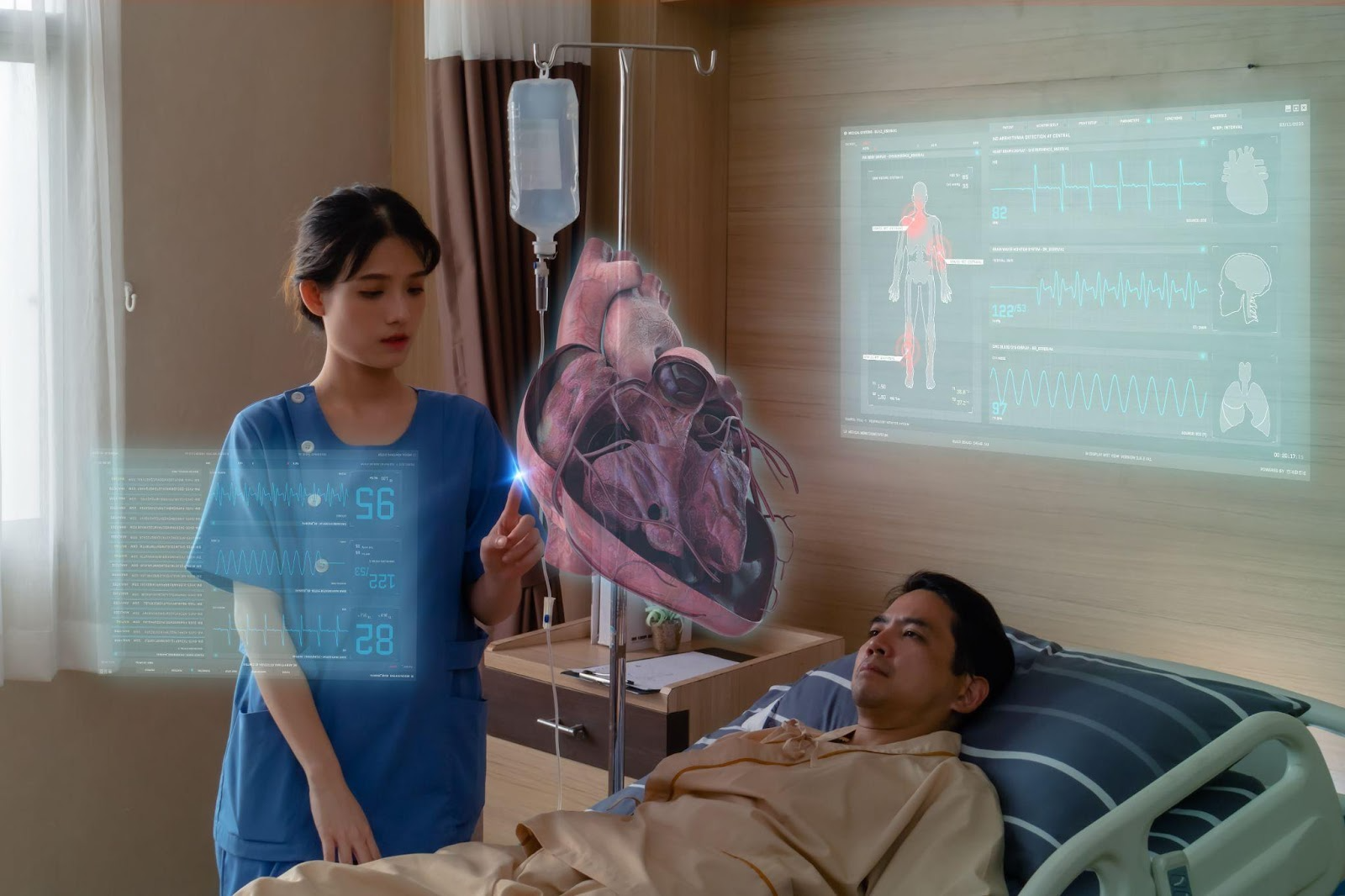
AI healthcare companies innovations sound like a mystery straight out of sci-fi movies, but that's the reality of this century. Imagine yourself walking straight into a hospital due to an emergency, and to your dismay, the doctor is not available, a worst-case scenario no one should ever experience. Fortunately, with the latest medical innovation, a doctor can treat their patient remotely thanks to the development of global connectivity like ESIMWORLD. Unlike the other industries, healthcare is not only a business; its existence is to protect humanity, and AI holds great promise for delivering high-quality healthcare and medicine worldwide. Countries around the world are striving hard to implement AI solutions into their healthcare systems for the benefit of their people. Especially countries like Singapore, which will be facing a huge aging population by 2030, have understood the need to revolutionize their healthcare to support the needs of their citizens. AI has already been introduced in monitoring patients' blood sugar levels, heart rate, etc., using IoT devices, which require seamless network connectivity. That is when technologies like eSIM come to aid and services like ESIMSINGAPORE support endless connectivity to your health monitoring devices even while you are travelling. The AI healthcare business is a booming industry, and organizations like the WHO are monitoring closely the ethical use of AI for the benefit of mankind.
“Like all new technology, artificial intelligence holds enormous potential for improving the health of millions of people around the world, but like all technology, it can also be misused and cause harm,” said Dr Tedros Adhanom Ghebreyesus, WHO Director-General.
The study of the human body is the most complex in the world. To diagnose a patient, a healthcare professional must understand these complexities, and will require a lot of tests to be performed to understand the problem. Hence, the aid of AI in healthcare will be a great tool to fill this gap. AI Healthcare companies are driving global innovation in the field of medicine through the use of artificial intelligence. These AI healthcare companies are reimaging how care is delivered, diseases are diagnosed, and treatments are developed. AI tools have the technology to process large data sets that are beyond the ability of humans to process, allowing for faster processing and quicker diagnosis, which in turn aids healthcare workers in providing personalized treatment for their patients.
These AI healthcare companies have been recognized globally and have created a greater impact in the healthcare industry. Current trends in Medical innovations are precision medicine based on genomics and data analytics, targeted treatments are possible, and drastically reducing the side effects of treatments. Telehealth and virtual care allow remote consultation, diagnostics, and follow-up, a trend that has increased after the 2020 COVID-19 outbreak. One breakthrough in AI healthcare companies is AI-powered diagnostics and imaging, which has drastically improved clinical decisions and also in early diagnostics. Some of these innovations are making major changes in the Medical industry.
Countries worldwide are rapidly embracing AI in healthcare. The United States remains at the forefront of AI investment, with an estimated spending of about $470.9 billion, with around 25% of U.S. hospitals already using predictive analytics to enhance patient care. Followed by countries like the United Kingdom, China, India, Israel, South Korea, Dubai, UAE, and so on. This is clear proof of how healthcare is being shaped in this century.
Singapore is at the forefront of smart nation initiatives, and its healthcare initiative to implement AI is among its priorities, as Singapore has a larger aging population, and hence, the demand for high-quality healthcare. Synapxe, Singapore’s national health-tech company, is committed to boosting AI in its health tech to increase productivity. Synapse has signed a collaborative deal with major tech companies to build an AI-driven medical ecosystem. Through the AI accelerator 2025, Synapxe brought healthcare and tech companies together to boost AI talents and capabilities to transform public healthcare. Some of the notable collaborations of Synapxe are with OpenAI (Chat services for transactional purposes like bookings), AIDXTech ( for identifying any risk), Databricks (a data, analytics, and AI company), and signed an MOU with Google Cloud. Synapxe, through these major collaborations, aims to pave the way for AI-enabled healthcare and enhance the public healthcare of Singapore.
“AI holds immense promise for transforming healthcare through innovation. By harnessing its capabilities, we are developing solutions that enhance predictive and personalized care and improve health outcomes for everyone.”
Says Ms Ngiam Siew Ying, CEO of Synapxe
Synapxe is collaborating with healthcare and tech companies to develop AI-driven tools. One such innovation is “Synseh” which uses computer vision and AI for tongue analysis to explore wellness, and ASPIRE, an early tool to diagnose sarcopenia in partnership with a national healthcare group. These initiatives aim to empower clinicians with early screening and proactive steps to support healthier aging in the community. Synapxe, Singapore’s national HealthTech agency, is committed to connecting people and systems to create intelligent solutions that improve the health of millions daily.
COVID-19 stretched the global healthcare systems to their limits. The unwavering commitment of countless healthcare professionals is the reason why many of us are still here today. The healthcare industry has recently been facing greater challenges, from a shortage of doctors to inefficient data systems, which in turn devalue the quality of healthcare services, demanding medical innovation. From Clinical to Administrative Issues, the healthcare industry has been facing larger issues that need immediate mitigation. Some of the key issues are:
AI healthcare business models are the perfect solutions for all the above-mentioned problems. Thanks to modern medical innovations, solutions for clinical and administrative issues can be solved by the latest AI technologies. AI-powered diagnostics uses AI algorithms to analyze medical images like X-rays, MRIs, and CT scans with higher efficiency than human clinicians in detecting diseases like cancer, diabetes, and more. These tools speed up the diagnosis, and with the help of these tools, healthcare workers can give quicker treatments and increase operational efficiency.
AI healthcare companies are dominating the digital healthcare landscape in 2025, capturing 62% of all venture capital funding and raising significantly larger rounds than their non-AI peers. Hospitals are undergoing major changes, like the adoption of AI to automate clinical documentation and cut operational costs. Pharma companies are also heavily investing in AI for drug discovery and clinical trial matching, driving innovation and efficiency across the health sector. Even health insurance companies are leveraging AI technologies to detect fraud and assess risk. Compared to other sectors that are trying to integrate AI, the integration of AI in the health sector is looked at as more promising by the general public and by industry experts.
Whether it's an AI doctor or a human doctor in a white coat, the fear of what they might tell us remains the same. AI isn’t here to steal your doctor’s stethoscope or replace their reassuring smile, but it's here to make things easier for both of you, so that lives can be saved at a faster pace. Dr. AI will not replace Dr. Human, as in the end, the doctors are going to treat a living, breathing human, not a robot. The future of the medical world will be the teamwork between doctors and algorithms that join forces for smarter and kinder care. With the increase in the aging population across the globe, the need for medical facilities has increased dramatically over the years, with all these astronomical medical innovations, in the far future, disease can no longer have dominion over mankind. The future of medicine includes a doctor, your smartwatch, and an AI assistant who never forgets a detail about you, because in tomorrow’s clinic, even Dr. Promt gets a table to sit. Who knows, in the future, AI robots may also perform surgeries. Does that sound scary? Let's not worry about it now. It is a question for the future.