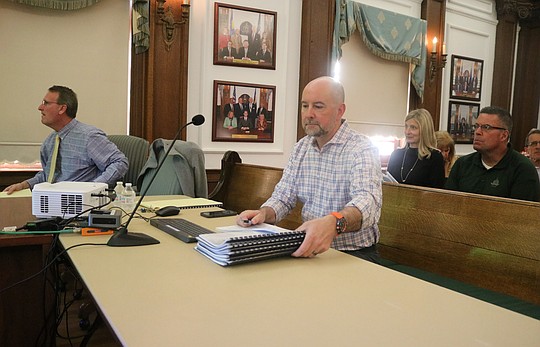
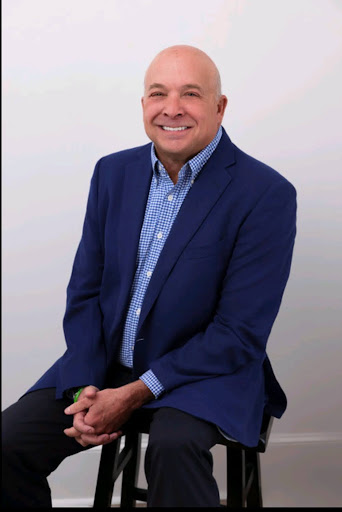
 Michael Langley sits in his Little Rock office fielding client texts on his cell phone, a practice that would make some attorneys cringe. For him, it’s just another day.
“All clients have my cell phone and email,” he says. “I direct them to text with questions or concerns. Much easier to include all proper staff that way.”
The approach is vintage Langley. A seasoned attorney with decades of experience in civil and administrative law, he has built his practice on a foundation that blends accessibility with old-school rigor. Technology serves the work, not the other way around. His law firm uses e-signature platforms and client management software called Lawmatics for initial contact. But beyond that? Personal, direct, no gatekeepers.
It’s a practice model rooted in something increasingly rare in modern law: trust. Not the kind you claim in marketing copy, but the kind you earn through consistency, discretion, and showing up when it matters. Michael Langley attorney has spent his career building that reputation across Arkansas, representing individuals and small businesses in cases that often hinge on creative legal maneuvering and a willingness to dig past the obvious answer.
One case stands out. A client wanted to move a liquor store to a new location. The opposition trotted out a familiar defense: the area was already sufficiently served. Standard playbook. Langley went digging and found a decades-old legal decision that redefined the geographic scope of need. The ruling said that if a permit already existed anywhere in the county, it had already determined the necessity to meet the need. Micromanaging smaller areas wasn’t part of the equation.
“I was able to use a decades-old legal decision that expanded the area and tied the board’s hands because the Court said if a permit already exists in the county, it has already determined that it was necessary to meet the need and micro areas were not the consideration,” Langley explains.
The case didn’t just win, it illustrated a broader principle that defines how he works: the first answer is rarely enough; you have to keep digging.
That instinct, part persistence and part paranoia, has shaped a legal career marked less by flash and more by results. Langley doesn’t claim to reinvent the wheel; he just knows where to look when the wheel breaks.
Ask Michael Langley Little Rock about his approach to complex legal cases and you get a straightforward response: “Solve the problem directly in front of you, then move on to the next one.”
No grand theory, no overthinking.
It’s a framework that sounds simple until you realize how rare it is. Lawyers love to complicate things. Langley strips them down.
When faced with a legal obstacle that lacks a clear precedent, he starts with what the law explicitly forbids.
“I start with what the law says you specifically cannot accomplish and then work up from there,” Langley says. “Where are the distinctions, and how do the facts apply? We then look for a common-sense application in a different circumstance that contradicts the case we are working on. We work through the differences and why it is good or bad for us before we use it.”
It’s methodical, almost clinical, but it leaves room for creativity, which Langley views less as flair and more as necessity.
“Court is a performance for 12 or 1,” he says, referring to juries and judges. “You have to know the audience and think in their direction. No cookie-cutter works here.”
That performance element matters. Legal arguments aren’t just about being right, they’re about persuasion, context, and understanding who’s listening. Langley has learned to calibrate his approach based on the room, the case, and the stakes. Sometimes that means leaning into precedent, other times it means finding the gap where precedent doesn’t quite reach and building something new.
One tactic he uses regularly is internal debate. “Technology helps but the best way is to have another lawyer take the other side and challenge each other,” Langley says.
They go back and forth, stress testing arguments before they ever see a courtroom. It’s a form of innovation that predates the internet.
Langley doesn’t let his associates touch property search software until they’ve done it the analog way, by hand, with books and records and the kind of grunt work that makes young attorneys question their career choices.
There’s a reason for that.
“I always want them to follow the tech but we train them from the basics,” Langley says. “They will learn how to do a property search by hand before moving to a computer. Drafting is the same way. They have to think about it and then, they can add tools.”
It’s not hazing, it’s pedagogy. Langley believes that understanding the mechanics behind the tools makes better lawyers. Knowing why a search works, not just how to run it, builds judgment. And judgment, in his view, is what separates competent representation from malpractice.
The same goes for legal writing. No templates until you’ve written from scratch, no shortcuts until you understand what you’re shortcutting.
“Innovation is tools,” Langley says. “Discipline and structure are mind and processes. We incorporate them into the system.”
That philosophy puts him at odds with the tech-first crowd in legal circles. While some firms chase the latest AI-powered research assistant or client portal, Langley adopts selectively. Lawmatics streamlines intake, e-signature saves time, but the core work, the thinking, stays human.
He mentors with the same approach: train hard, question assumptions and don’t rely on software to do your thinking. The result is a pipeline of younger attorneys who know how to function when the Wi-Fi goes out.
It’s deliberate, and in an industry increasingly shaped by automation and outsourcing, it stands out.
Michael Langley Little Rock legal practice doesn’t exist in a vacuum. Laws change, courts issue new rulings and technology evolves. Staying relevant requires effort.
“I do my best to follow blogs, twitter and court updates to stay current,” Langley says.
It’s not a revolutionary system; it’s consistent. He tracks developments, monitors legal commentary, and pays attention to shifts that might affect his clients. The goal isn’t to chase every trend; it’s to know when something matters.
That discernment shows up in how he integrates new ideas into his practice. He doesn’t adopt innovation for its own sake, he tests it. If it improves client outcomes or makes the work more efficient without sacrificing quality, it stays. If it’s just noise, it goes.
The balance between innovation and discipline defines how he runs his firm. “We don’t abandon the way we do things for a new piece of innovation,” Langley says.
That caution has served him well. While other firms chase the next big thing, Langley focuses on what works. He’s not allergic to change. He’s just selective about it. And in a profession where bad decisions can cost clients money, freedom, or worse, selectivity matters.
His approach to legal strategy reflects the same pragmatism. When generating fresh ideas for a case without clear precedent, he doesn’t start with what might be possible. He starts with what’s prohibited.
From there, it’s a process of elimination and exploration. He looks for analogous situations, tests their relevance, and builds arguments that fit within the existing legal framework. It’s creative, but grounded. Innovative, but disciplined.
Michael Langley attorney practice in Little Rock continues to operate on principles that feel increasingly countercultural: accessibility, accountability and a belief that people deserve fair representation and second chances.
He’s active in the community, supporting local nonprofits and mentoring early-career legal professionals. He contributes to conversations around access to justice and legal literacy, topics that matter in a state where many people can’t afford quality representation.
His work is grounded in values that sound simple but require daily reinforcement: integrity, respect, and the idea that the legal process shouldn’t be a mystery to the people it affects most.
That commitment shows up in small ways: answering texts, returning calls, and taking time to explain options instead of dictating strategy. It’s not flashy but it builds trust, and trust is the currency that matters most in legal work.
Looking ahead, Langley remains focused on the fundamentals. He’s not interested in scaling into some regional powerhouse or franchising his approach. He wants to keep doing the work, serving clients who need representation, and training younger lawyers to do the same.
The legal field will continue to change but the core of what Langley does, the part that involves listening to clients, thinking through problems, and advocating with clarity and purpose, that stays constant.