We spend a massive amount of energy trying to keep our bodies young. We join gyms, we track our macros, and we buy expensive face creams to fight off gravity. Yet, we often neglect the most critical muscle we own: the brain.
As we age, cognitive sharpness doesn't just stick around by accident. It requires maintenance. For years, we were told that doing a daily crossword puzzle or playing a lonely game of Sudoku was enough to keep the cobwebs away. While those puzzles are fine, they lack the dynamic chaos of real life. They are static. The brain needs a challenge that involves variables, speed, and human interaction.
This is why doctors and neuroscientists are increasingly pointing toward complex strategy games as a defense against cognitive decline. Specifically, the ancient game of Mahjong is emerging as one of the most powerful tools for mental longevity. It is widely considered a full-brain workout because it forces you to use multiple cognitive functions simultaneously. You aren't just solving a math problem; you are managing probability, memory, and social psychology all at once.
If you are looking for a way to stay sharp that feels more like a party and less like homework, here is the science behind why this tile-based game is the ultimate cognitive superfood.
In many games, you take a turn, and then you zone out while waiting for the next one. In this game, zoning out is fatal.
Your brain is constantly engaged in what neurologists call executive function. This is the management center of the brain responsible for planning, organizing, and focusing attention. During a single hand, you are juggling three distinct realities:
This requires a high level of split attention. By forcing your brain to process multiple streams of information in real-time, you are strengthening the neural pathways that handle complex decision-making. It keeps the mind flexible and fast, preventing the rigid thinking patterns that often come with age.
One of the first things to slip as we get older is short-term memory. We walk into a room and forget why we are there.
This game acts as a resistance training program for your memory recall. Unlike cards, where you might only need to remember a few high-value trumps, here you need to remember the status of 144 distinct tiles. "Did the player to my left discard the 7-Dot, or was that the player across from me?"
You are constantly retrieving information from the last 30 seconds to inform a decision you are making right now. This constant cycle of encode, store, retrieve keeps the hippocampus—the part of the brain responsible for memory—active and healthy. Studies have shown that regular players have better digit-span memory and verbal memory than non-players.
Have you ever noticed how fast an experienced player moves? They don't stare at a tile for five seconds to figure out what it is. They glance at it, and their brain instantly categorizes it.
This is visual processing speed. The game requires you to scan a chaotic table of symbols and instantly recognize order. You are looking for sequences (Chows), triplets (Pungs), and matching pairs.
This visual hunting keeps the brain’s processing speed high. It trains your eyes and your mind to communicate instantly. In the real world, this translates to better reaction times—whether that’s driving a car or catching a glass before it falls off the counter. You are training your brain to cut through visual noise and find the signal.
Perhaps the most underrated brain benefit is the social aspect. Loneliness and isolation are two of the biggest risk factors for dementia and cognitive decline. When we stop talking to people, our brains atrophy.
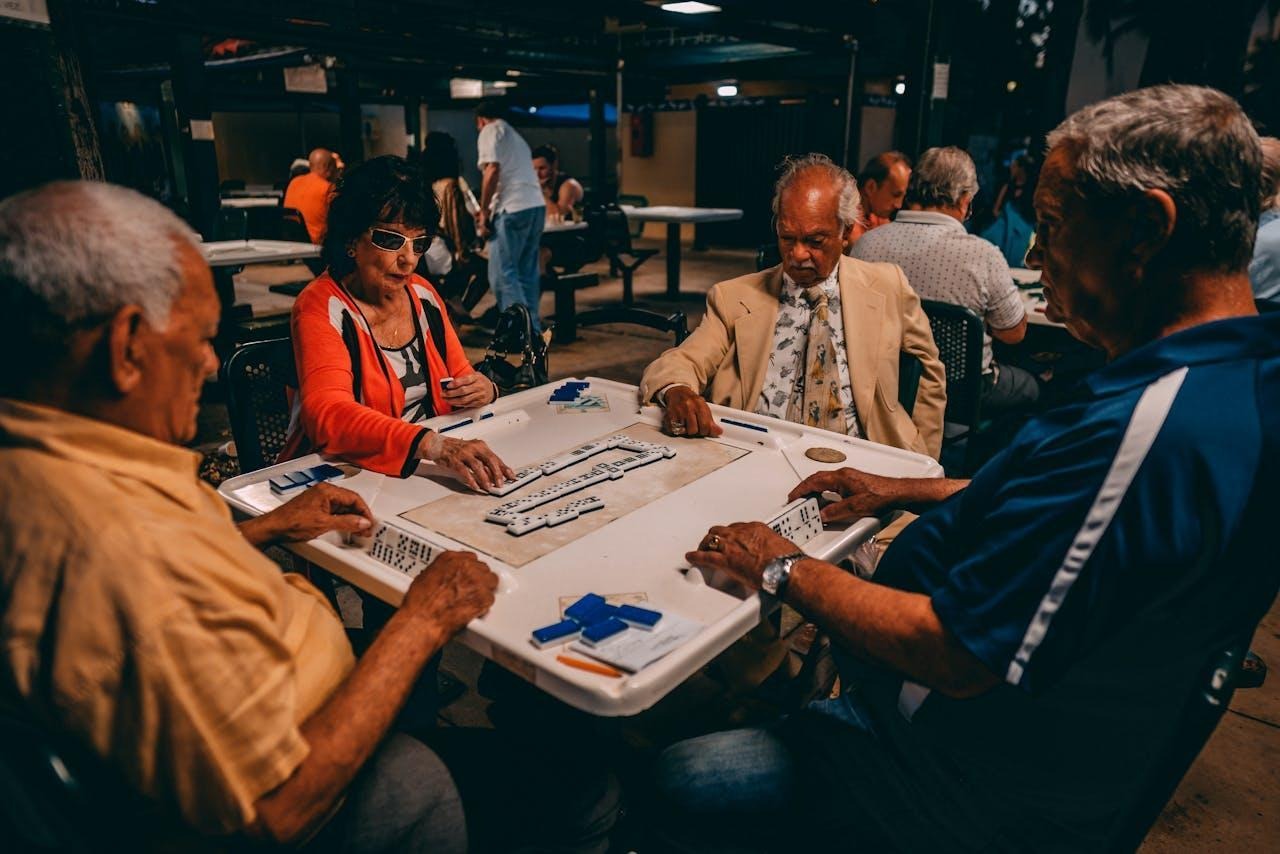
You cannot play this game alone (at least, not the traditional way). It requires four people sitting at a square table. It forces interaction. You are chatting, you are reading body language, and you are engaging in banter. This social friction is crucial. Processing conversation while simultaneously calculating game strategy lights up the brain like a Christmas tree.
It provides a regular social ritual. Knowing you have a game every Tuesday night gives you a sense of purpose and community, which drastically lowers cortisol levels (stress) and boosts serotonin. A happy, socially connected brain is a resilient brain.
Finally, there is the benefit of simply learning something hard. If you have played the same card game for 40 years, your brain is on autopilot. You aren't building new connections; you are just traveling down old, paved roads. This game is complex. There are different variations (Hong Kong, American, Riichi), intricate scoring rules, and infinite strategic possibilities.
When you learn these rules, you trigger neuroplasticity. This is the brain's ability to rewire itself and grow new connections. It is the biological equivalent of forging a new trail in the woods. Every time you learn a new scoring combo or a defensive strategy, you are physically changing the structure of your brain, building a cognitive reserve that acts as a buffer against aging.
We often think of brain training as a chore—something we should do, like eating kale. But the most effective brain training is the kind you actually want to do.
This is why this game has endured for centuries. It is addictive, it is loud, and it is fun. It tricks you into doing a heavy mental workout by disguising it as a social gathering. So, if you want to keep your mind razor-sharp well into your golden years, don't just buy a puzzle book. Call three friends, set up a table, and start shuffling. Your brain will thank you for it.