
When Elon Musk said that ‘in less than 20 years, none of us will be working thanks to artificial intelligence’, some professionals felt like he was being dramatic.
But is he, though?
Think about the things that your traditional AI agents can do for a moment. Isn’t it mind-blowing?
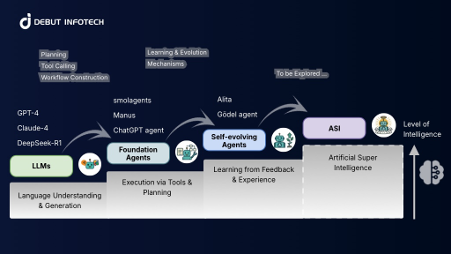
But it gets even more ridiculous with the rise of a new level of AI agents known as self-evolving AI agents.
Yes, AI is expected to make computers and machines simulate human learning. But traditional AI systems still relied heavily on human input.
This new, ‘self improving AI agents’? They get better on their own.
In this article, we’ve taken a quick dive into what they really are, how they improve, and, most importantly, why and how businesses can start taking advantage of them right now.
Come find out!
Per multiple research studies on the advancement of AI technology, self-evolving AI agents are a new class of AI systems that can transform themselves based on their experiences. This often translates into an inherent ability to adapt and improve their actions and outputs as the data they’re interacting with changes.
Here’s why this new class of AI agents is so groundbreaking:
You see, while older AI systems are very powerful, they tend to be very static also. This means they rigidly follow the rules they were built on and strictly abide by the data engineers' specifications, so much so that even when the environment changes, the AI doesn’t adjust without human intervention. This is usually why some of the responses you get from customer service chatbots or LLM models sound dumb.
But self improving AI agents are built to change this equation.
Instead of staying frozen in time, they learn, reorganize, and refine their capabilities as they work.
So what makes an agent “self-evolving”?
The following are some key hallmarks:
This is how you can distinguish a traditional agent from a self evolving AI agent.
Now that we’ve covered what self-evolving agents are, the next logical question is: how do they actually get better on their own? Because the magic of these systems isn’t just that they “run tasks”—it’s that they upgrade themselves while doing it.
At a high level, every self-evolving agent follows a simple loop:
act → evaluate → improve.
But the way they execute this loop can be surprisingly sophisticated.
A big part of their evolution comes from something called reward-based learning. And no, this isn’t as abstract as it sounds. It’s basically the agent paying attention to its own outcomes and asking, “Was this a good decision?”
The feedback can come from anywhere—textual critiques, system signals, internal confidence scores, or even tiny scalar rewards embedded in the context. These agents treat every interaction like a data point, and every data point like a chance to become smarter. It’s the same way great teams run post-mortems after releases… except the agent runs thousands of them silently in the background.
Another fascinating mechanism is imitation learning, but not the old-school version that depends on humans labeling examples. These new agents generate their own demonstrations. They craft problems, solve them, inspect what worked, and fine-tune themselves based on the best reasoning patterns they discover.
Some even learn from other agents by sharing successful strategies—almost like digital peer learning groups.
There’s also a more biologically inspired approach where multiple agent variants run at once and evolve over time. Weak strategies die off. Stronger ones propagate. Some systems even keep archives of all past versions so the agent can branch off in new directions whenever needed.
Within this evolutionary bucket lies one of the most powerful techniques: improving autonomous AI agents with reflective tree search and self-learning. Here, the agent simulates possible paths, critiques each one, and prunes bad strategies before committing. In short, it learns to think better by thinking about its thinking.
At this point, you might be wondering: Okay, self-evolving AI agents sound cool—but why should businesses care right now?
Well, the truth is, we’re entering a phase where companies that rely on static AI systems will feel increasingly outdated. Meanwhile, organizations adopting self improving AI agents will start compounding advantages the same way early cloud adopters did a decade ago.
This is also why many forward-thinking leaders are choosing to hire AI agents developers to build adaptive, resilient AI infrastructures from day one.
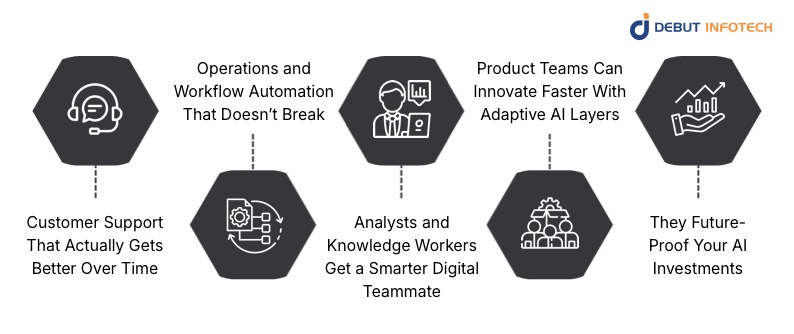
Here’s where these agents are already making a real difference.
Traditional chatbots are famous for giving annoying, irrelevant answers. Why? Because they never adapt.
Self-evolving AI agents flip this dynamic. Every ticket handled, every correction, every user frustration becomes training fuel. So instead of plateauing, these agents reduce handle times, improve resolution quality, and deliver more human-like responses over time. For enterprise support teams, this translates into higher CSAT scores and significantly fewer escalations.
Static automations are fragile. Change one tool or process, and suddenly the whole system collapses.
But self-evolving agents adjust automatically. They identify bottlenecks, rewrite their own workflows, and adapt to new tools without months of re-engineering. This is where technologies like reflective tree search and self-learning for autonomous AI agents really shine—they enable agents to analyze multiple possible execution paths and choose the best one.
The business impact?
Faster processes, lower error rates, and smoother ops—especially in logistics, procurement, and finance.
Imagine having a research assistant who gets better at your job every day.
Self-evolving AI agents can analyze data, rewrite SQL queries, refine search strategies, and adapt to your company’s unique knowledge base. They learn from each task, so complex insights they struggled with last month become effortless today.
Result: Your teams move from manual grunt work to real decision-making.
Companies building AI-powered products face a common issue: constant model updates.
Self-evolving agents reduce that burden. They refine their own prompts, tools, and behaviors as customers use the product—letting engineering teams focus on new features instead of endless maintenance.
This gives businesses a massive competitive edge in markets where speed is everything.
Markets change. Policies change. Customer expectations change.
Self-evolving AI agents change with them. This is why self-evolving AI agents are becoming a foundational layer for modern enterprises—they turn AI from a fixed asset into a continuously improving one.
Now you know that self-evolving AI agents can do wonders for your business. But how do you start introducing them into your operations?
Here’s a simple, practical roadmap to help you begin.
Instead of trying to rebuild your whole operation overnight, you need to select a single workflow where a self-evolving agent can learn safely and produce visible wins. This could be research assistant systems, analytics automation engines, or support ticket operations. It doesn’t matter. Just choose one where there is usually constant feedback and start from there.
If you’re still unsure where to start, try speaking with any of our experienced AI consultants at Debut Infotech Pvt Ltd so that you can get insights on how to assess your operations.
We’ve made it clear that self-evolving agents thrive on feedback. Therefore, you need basic evaluation metrics, traceability, and lightweight guardrails. This allows you to keep track of changes and see your AI system progress gradually.
The more tools an agent can interact with (CRMs, ERPs, APIs, databases), the faster it improves. This is also where approaches like improving autonomous AI agents with reflective tree search and self-learning become powerful because the agent can test different tool paths and adopt the smartest ones.
If you’re planning to build an AI agent from scratch, integration design matters more than most people expect.
Implementing self-evolving agents involves orchestrating tools, designing feedback systems, aligning metrics, and ensuring the agent evolves safely. This is exactly where specialized AI agent development services like Debut Infotech Pvt Ltd can save you months (and sometimes years) of trial and error.
The rise of self-evolving AI agents marks a major turning point in how businesses will operate in the coming years. We’ve moved from static tools that need constant human babysitting to intelligent systems that learn, adapt, and refine themselves as they work. And whether it’s smarter customer support, streamlined operations, or workflows that improve on their own, the companies that tap into this shift early will gain an undeniable edge. The future isn’t just automated — it’s adaptive. And now is the perfect time for forward-thinking businesses to start exploring what these agents can do for them.







