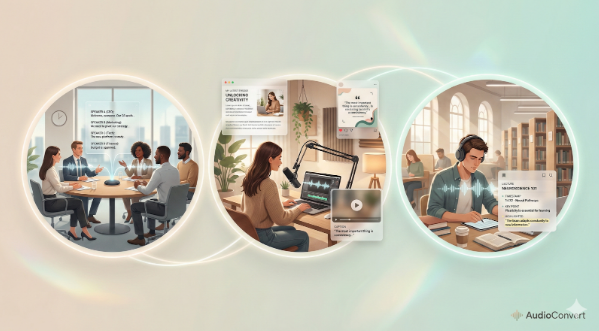
In today's fast-paced digital environment, converting audio and video content into accurate text has become essential for professionals across industries. Whether you're managing team meetings, conducting interviews, or processing educational content, having a reliable transcription solution can dramatically improve productivity and information accessibility.
The demand for efficient audio-to-text solutions has surged as remote work and digital collaboration become standard practice. Organizations generate massive amounts of audio content daily through virtual meetings, webinars, client calls, and recorded presentations. Without proper transcription tools, this valuable information remains locked in formats that are difficult to search, reference, or repurpose.
Traditional transcription methods present significant challenges. Manual transcription typically requires three to four hours of work for every hour of audio, creating substantial labor costs and turnaround delays. Professional transcription services often charge between $1 to $3 per minute of audio, making them cost-prohibitive for regular use. These limitations have driven the adoption of AI-powered solutions that deliver comparable accuracy at a fraction of the time and expense.
When evaluating transcription technology, accuracy stands as the primary concern. Professional environments require precision rates above 95% to ensure transcripts are usable without extensive editing. The Audio To Text Converter delivers 99%+ accuracy through advanced AI models that adapt to various accents, technical terminology, and speaking styles. This level of precision eliminates the reliability concerns that plagued earlier automated transcription attempts.
Beyond basic transcription, professional workflows demand contextual features. AudioConvert automatically distinguishes between multiple speakers, labeling their contributions throughout the transcript. This speaker diarization proves invaluable for meetings, interviews, and panel discussions where attributing statements to specific individuals matters. Integrated time-stamping allows users to jump directly to relevant audio segments, transforming static transcripts into navigable reference documents.
The platform addresses real-world transcription challenges through a comprehensive feature set designed for professional requirements. Understanding these capabilities helps organizations assess whether this Audio To Text Converter aligns with their operational needs.
Global operations require transcription tools that handle linguistic diversity. AudioConvert supports over 100 languages with consistent accuracy, enabling organizations to process content from international meetings, multilingual customer interactions, and cross-border collaborations. The system automatically detects the source language, eliminating manual configuration steps that slow down transcription workflows.
Raw transcripts, while searchable, still require time to review. AudioConvert addresses this through one-click intelligent summarization that generates structured outputs tailored to specific use cases. Meeting transcripts transform into action-item lists and decision summaries. Lecture recordings become organized study notes with key concepts highlighted. Interview transcripts condense into thematic briefings that capture essential insights without requiring readers to parse thousands of words.
The platform exports transcripts in TXT for simple text processing, DOCX for editing in standard word processors, and SRT for subtitle creation. This flexibility ensures transcripts integrate seamlessly into existing documentation systems and content management platforms. AudioConvert implements end-to-end encryption for all uploads and processing, ensuring audio content remains protected throughout the transcription lifecycle, addressing compliance requirements for industries handling sensitive data.
Understanding how organizations deploy this Audio To Text Converter reveals its practical value beyond technical specifications. Real-world applications demonstrate where transcription technology delivers measurable operational improvements.
Executive teams and project managers use AudioConvert to capture meeting discussions without dedicating staff to note-taking. Transcripts provide accurate records for decision documentation, help absent team members catch up quickly, and create searchable archives for referencing past discussions. The speaker identification feature proves particularly valuable in attributing action items to specific team members.
Podcasters, video producers, and content creators leverage transcription to repurpose audio content efficiently. Podcast transcripts improve SEO by making episodes searchable to Google. Video transcripts become blog posts, social media content, and email newsletter material. This content multiplication strategy maximizes the return on investment for produced media without additional creative effort.
Researchers conducting qualitative interviews use AudioConvert to transcribe participant responses quickly and accurately. Students record lectures and convert them into searchable notes for exam preparation. The time-stamping feature allows both groups to return to specific audio sections when they need clarification or want to verify quotes for academic citation.
As organizations increasingly produce written content at scale, distinguishing between human and AI-generated text has become operationally important. The AI checker provides instant analysis to identify content created by ChatGPT, GPT-5, Claude, Gemini, and other large language models. Educators use it to assess student submissions, publishers verify contributor authenticity, and hiring managers evaluate application materials. The tool delivers sentence-level analysis with clear confidence scores, eliminating false positives that damage trust in detection systems.
Deploying an Audio To Text Converter effectively requires understanding how it fits within broader operational workflows. Organizations achieve optimal results when they approach implementation strategically rather than treating transcription as an isolated capability.
The most successful implementations connect transcription outputs directly into existing knowledge management systems, project management platforms, or content repositories. While 99%+ accuracy represents industry-leading performance, establishing light review processes for high-stakes transcripts ensures critical documents meet organizational standards. This balanced approach captures remaining errors without negating the time savings that make automated transcription valuable.
Quantifying transcription value helps justify technology investments and guide expansion decisions. Organizations should track metrics like transcription turnaround time, cost per minute compared to previous solutions, and downstream productivity improvements from searchable content. These measurements demonstrate concrete benefits and provide data for budget discussions.
Professional audio transcription has evolved from a specialized service into an accessible productivity tool that organizations across industries can deploy immediately. AudioConvert combines the accuracy, speed, and feature depth required for professional use while maintaining security standards appropriate for confidential content. As audio and video content continues proliferating in digital workflows, having reliable transcription capability transitions from a convenience to a competitive necessity.