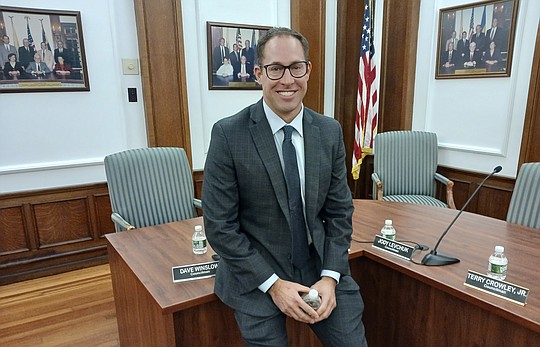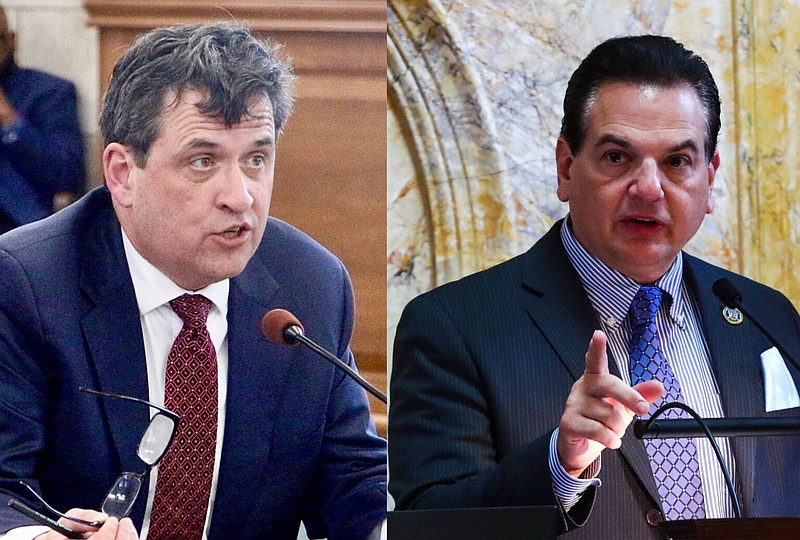
Acting state Comptroller Kevin Walsh, left, is blasting a new bill from Senate President Nicholas Scutari that would weaken the powers of Walsh’s office. (Photos by Dana DiFilippo/New Jersey Monitor)
By Dana DiFilippo
Reprinted with permission
New Jersey Monitor
Acting State Comptroller Kevin Walsh hit back Wednesday at a top New Jersey legislator’s effort to weaken his office’s investigative powers, calling it a “scam” that will allow corruption to flourish unchecked.
Sen. Nicholas Scutari (D-Union) introduced a bill Monday to transfer the comptroller office’s investigative and subpoena powers to the State Commission of Investigation, and the bill is scheduled to be heard by a legislative committee Monday morning in Trenton. Walsh told reporters Wednesday the measure is designed to keep the public and Gov.-elect Mikie Sherrill from “continuing to go after corruption in our state.”
“It is designed to undermine an extraordinarily effective watchdog agency. It is designed to reduce the power of the governor to address corruption, especially at the local level. It is designed to shut down ongoing investigations we are involved in,” he said.
The State Commission of Investigation already has investigative and subpoena powers, Walsh added.
“So that just shows, really, what a scam the entire concept of the bill is,” he said.
Walsh’s investigations into public fraud, waste, and abuse have tormented officials at all levels in New Jersey, driving critics to demand that state lawmakers muzzle a watchdog that reformers revere as one of New Jersey’s most effective guardians against government misconduct.
Critics’ demands for a comptroller crackdown started early last year, Walsh said. He finds that timing notable.
In December 2023, he issued a report that rebuked public payments made to several Scutari associates, including Edward Oatman, who was Scutari’s chief of staff before he was appointed Union County manager in 2018.
Walsh’s investigators found that Union County improperly paid several top officials, including Oatman, more than $400,000 in stipends and tuition reimbursements. Walsh recommended that the county work to recover the improperly paid funds, institute a corrective action plan, and be more transparent in such payments. Instead, state lawmakers moved to loosen compensation rules for county officials, although that legislation subsequently stalled.
“There is a discomfort that comes with being the subject of a report where you’re called out for doing something wrong. But our democracy is supposed to be strong enough to handle that sort of truth,” Walsh said. “I can’t speak to Sen. Scutari’s motivations in particular based on that report, but the timing is noteworthy.”
Oatman did not respond to a request for comment.
Scutari’s bill also would put legislators in charge of appointing the chair of the State Commission of Investigation, more than double the part-time commissioners’ salaries, and give the commission’s chair the authority to seek a wiretap in cases involving misconduct by state Department of Law and Public Safety employees. That department houses the state police and the Attorney General’s Office.
Walsh pushed back on all of those provisions. He called the pay hikes wasteful and said shifting appointment authority for the commission’s chair to the Legislature would politicize an oversight agency whose independence should be fiercely protected. Right now, the governor names the commission’s chair.
“We don’t do wiretapping right now. That’s a law-enforcement power, and this would seemingly, with little or no checks, grant SCI that power,” he said.
Scutari, who is the highest-ranking state legislator as Senate president, did not respond to a request for comment.
His bill says it aims to eliminate “overlap” in the two watchdogs’ missions and that the comptroller’s “core work … will continue unabated.”
Walsh disputed those claims too, saying the agencies have had no conflicts because they “generally try to stay out of each other’s way.”
He added: “Our core powers right now include the power to investigate public corruption.”
The office gets hundreds of tips of public corruption and waste a month, Walsh said. He cited multiple examples of major investigations his office has done that would have been impossible without investigative and subpoena powers, including exposing a police training firm’s controversial teachings, oversight lapses that led Essex County to pay millions to ghost employees carrying out its pandemic vaccination work, and the misuse of opioid settlement fund spending in Irvington.
Besides investigations, the office, which has about 130 employees, also audits public agencies, reviews public contracts, and oversees the Medicaid program. The comptroller’s office would continue that work under Scutari’s bill.
The bill is set to be heard at 10 a.m. Monday before the Senate’s state government committee at the Statehouse in Trenton. Advocates from the American Civil Liberties Union of New Jersey plan to join Walsh in testifying against it.
“It does a lot of damage in a moment where there is heightened distrust of government. We need more watchdogs, not fewer,” said Amol Sinha, the group’s executive director. “The idea that there is too much oversight in New Jersey is just false and disregards what people want to see, which is politics and governance that are uncorrupted.”
The police accountability work Walsh’s office does, alone, is reason why policymakers should preserve its investigative and subpoena powers, Sinha added. Walsh’s office has investigated the police practice of “courtesy cards” and lapses in public reporting of police misconduct, among other things, and annually reviewed state police compliance with reforms intended to prevent racial profiling.
“Since we cannot rely on the federal government to engage in consent decrees or pattern and practice investigations the way they once used to, we need all of the support that we can get at the state level to conduct that oversight, and it’s all the more important that we have an effective Office of the State Comptroller that can hold state police accountable,” Sinha said.
The feds have dropped oversight of and investigations into several troubled New Jersey police departments recently, including Newark and Trenton.
Walsh is almost six years into his term, but doesn’t expect he’ll serve much past Jan. 20, when Sherrill takes over from Gov. Phil Murphy. New governors typically install their own people.
But he said he’ll fight hard against Scutari’s bill anyway to protect both the comptroller office’s in-progress probes and its mission of protecting public integrity and taxpayer money.
“I’m thinking of this both as impacting the ongoing investigations that have started under my leadership, and additionally impacting whoever leads the office, prospectively,” he said.
He said he hasn’t spoken with Sherrill, Murphy, or the commission’s leaders about Scutari’s bill, but added it would be “pretty extraordinary” if Murphy signed it. Tyler Jones, a Murphy spokeswoman, declined to comment.
“No governor should permit what is occurring here, which would be hamstringing, undermining, the executive branch from policing itself,” Walsh said. “We all have an obligation to protect the important institutions of our government.”