If you’re exploring a cargo e-bike for families, you’re probably wondering what’s safe at each age, which accessories really matter, and whether a long-tail cargo e-bike can handle your school runs and errands. This guide walks you from infant to grade-schooler—covering equipment, loading routines, and ride techniques—then spotlights a representative long-tail build so you can see what solid performance looks like.
Start with medical guidance, then match the carrying method to your child’s size and neck strength. The American Academy of Pediatrics advises that infants under 12 months should not be carried on a bicycle because they’re too young for a helmet and can’t support their heads; for older babies and toddlers, bike trailers and approved child seats become options.
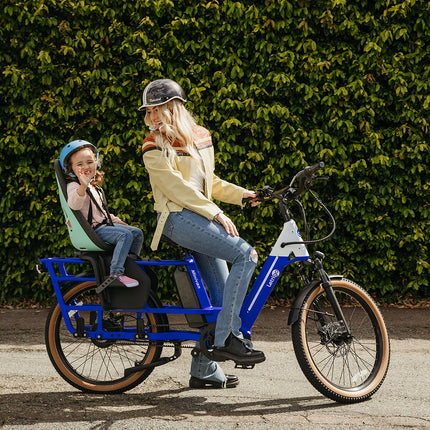
For toddlers who can sit well and wear a helmet, either a rear child seat on a long-tail or a quality trailer can be appropriate; each has trade-offs. Trailers keep the center of gravity low and are very stable, though they ride wide and sit low in traffic. Child seats keep the footprint compact and maneuverable but change the bike’s balance, so a steady mounting routine and a sturdy kickstand are essential.
As kids get bigger, switch from child seats to a rear bench with handholds/rails and protected footrests so little feet can’t contact spokes. Brands that specialize in family cargo bikes emphasize four elements for passenger safety: a secure seat, harness/handhold, dedicated foot support, and foot/leg protection. Those principles apply no matter which brand you buy.
Helmet rules are non-negotiable for all passengers old enough to ride, and you should always respect weight limits for both the bike and each accessory.
A long-tail cargo e-bike extends the rear rack to carry one or two kids plus bags without feeling like a boat to steer. Compared with front-loaders, long-tails fit through typical doorways and elevators more easily and ride much like a standard bike—useful when you’re juggling pickups, groceries, and tight bike parking. That familiarity shortens the learning curve for new family riders, which is why long-tails dominate school-run routes in many cities.
Focus on parts that increase control and predictability with extra mass:
Keep a simple pre-ride ritual: check tire pressure, squeeze the brake levers, tug the seats/rails to confirm they’re tight, and confirm battery level.
Load the heaviest child closest to the rider and keep cargo low and centered. When starting, select a low gear and a modest assist level so power arrives smoothly; stand tall over the bike, look ahead, and take a beat before pushing off. Practice three start-and-stop cycles on flat ground, then add a mild hill with a safe runout. Choose calmer streets and protected lanes where possible, and consider a route that minimizes left turns and complicated intersections when you’re learning.
For a concrete picture of a modern long-tail, look at the Letrigo Minivan. It uses an Ananda Cargoline mid-drive rated at 500W (peaking at 750W) with up to 130 Nm of torque—plenty for neighborhood hills with passengers. The bike supports a dual-battery system; Letrigo cites ~45 miles on the standard 48V/14Ah pack, ~80 miles with an extra 14Ah, and up to ~120 miles with a 25Ah add-on (range varies by load/terrain). For low-maintenance drivetrains, it pairs a Gates CDX carbon belt with an Enviolo internal gear hub. Stopping power comes from Tektro HD-E725 four-piston hydraulics with 180 mm rotors, and the load capacity is listed at 450 lb total (with 140 lb on the rear seat). A connected waterproof TFT display adds GPS tracking, remote lock, Bluetooth/app alerts, and OTA updates—useful for security on a family bike.
In short: smooth starts, decisive braking, long-range options, and thoughtful passenger hardware—exactly what beginners should look for in a cargo e-bike for families.
Bring the real load: a child seat or bench, a backpack with water jugs or books if your kid isn’t riding yet, and your everyday lock. Try low and mid assist on flats, then do a gentle hill start. Confirm you can plant your feet confidently at stops without the bike tilting into the child seat. Practice walking the bike through a doorway or elevator; slow-speed control while dismounted matters as much as the ride itself.
Ease into the routine with familiar short routes and a five-minute time buffer. Keep a small kit on board (mini-pump, tire plugs/patches, multi-tool, disposable gloves) and recharge after rides so you’re always “ready for school run.” Schedule a quick weekly check of brake pad wear, belt tension (or chain wear if your bike uses a chain), and bolt torque; heavy loads magnify small adjustments. For weather, add seat-specific rain covers and warm gloves for shoulder seasons; for summer, a light sunshade and extra water go a long way.
Family biking becomes second nature quickly. Choose a long-tail cargo e-bike for the simplest learning curve, follow age-appropriate carrying methods (no passengers under 12 months), prioritize brakes/tires/foot protection, and develop a calm loading routine. When you’re ready to see a full-featured build, the Letrigo Minivan shows how a family-focused long-tail can deliver torque, range, and safety-minded hardware in one package.