Let's face it, multi-family investments can be a goldmine, often delivering returns that hover around 10% annually – a pretty sweet deal, right? But don't let those numbers fool you; the US real estate market can be a wild ride, like for example Minneapolis, MN Commercial real estate. Smart investors know that solid risk assessment is absolutely critical to avoid critical real estate mistakes. I consider it important for your success. Understanding potential pitfalls – and knowing how to sidestep them – is the key between a lucrative venture and a financial sinkhole.
That's where my experience kicks in. I've spent over two decades in the trenches, weathering economic storms and learning the ropes. I've refined a data-driven methodology that helps me confidently make profitable decisions in the US multi-family arena. So, join me as I share the models, strategies, and insights I use every single day.
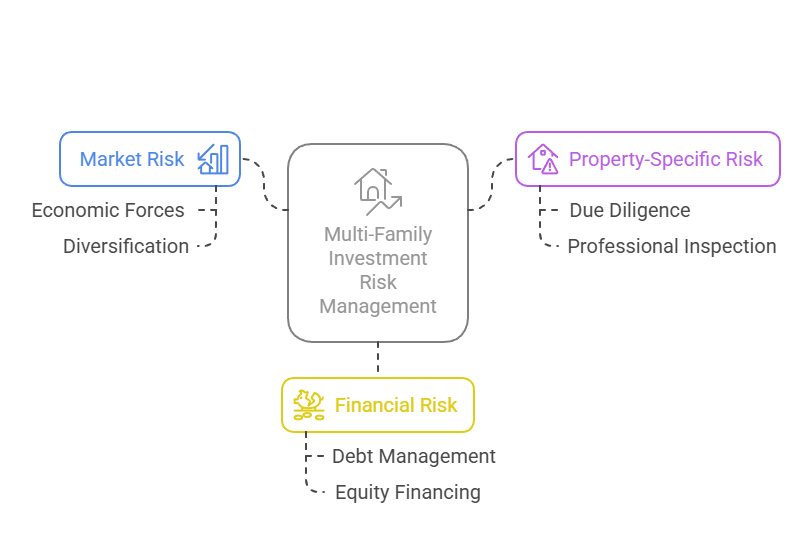
Think of market risk as the 'big picture' stuff – the economic forces that can push property values and rental income up or down. I learned this lesson the hard way. Back in '08, I had a bunch of properties in Vegas. The tourism industry tanked, housing prices plummeted, and suddenly my rental income dried up. Ouch! Diversifying to expand a portfolio is very important. That taught me the vital importance of spreading my investments around.
This is the risk locked up in each individual property. I remember buying what looked like a great apartment building, only to discover a huge foundation problem later. I needed big time repairs. The lesson? Never, ever skimp on due diligence. Get a rock-solid inspection before you sign on the dotted line – from a reputable professional.
Financial risk boils down to the potential for losses stemming from debt and those dreaded cash flow crunches. I like to use a mix of fixed-rate debt and equity financing. Sure, it might cap my potential upside a bit, but it gives me stability and shields me from interest rate shocks. Call me boring, but I sleep better at night!
The IRR is my bread and butter. It tells you the discount rate where the net present value of all cash flows hits zero. I always look at it. But here's the thing: IRR doesn't tell the whole story! Take it with a pinch of salt. Always pair it with other key metrics like NPV (Net Present Value), cash-on-cash return, and a clear-eyed understanding of the risks.
Sensitivity analysis is all about stress-testing your investment. What happens if key assumptions change? I'm using it constantly. For example, in my last investment, I ran a sensitivity analysis on occupancy rates. According to data, occupancy has to drop below 80% for me to see negative cash flow. Given my extensive market research, that is a risk I'm willing to take.
Monte Carlo is your crystal ball. This uses statistical modeling to forecast a range of potential outcomes by inputting data ranges. For example, to run a Monte Carlo simulation of a commercial real estate investment credibly, you need to define distributions for key variables: Rental Income, Operating Expenses, and even Exit Cap Rate. It will helps to find your expected returns and your probability of reaching it.
Data Collection
Garbage in, garbage out! You need accurate data to make smart decisions. Commercial Real Estate data comes from CBRE, Marcus & Millichap, and local government websites for digging up demographics and economic data. I dump all this data into Excel or Google Sheets to organize, analyze, and track it.
Model Selection
The right model depends on what you're investing in and what data you have. I start with IRR and then I analyze the data with other methods that I have told you about! Am I looking at a boring, stabilized asset? Or a complex deal with lots of moving parts? If it's the former, IRR is all I need. If it's the latter, I dust off my Monte Carlo.
Interpretation & Action
Knowing when to apply data is important as well. I use a super-simple checklist with three sections to interpret it. "Key Risks", "Mitigation Strategies," and "Action Items." Feel free to use the formula.
Okay, let's talk about a winner. A few years back, I dug into a 150-unit apartment complex in Austin, Texas. The IRR and sensitivity analysis pointed to solid returns, even with higher operating expenses. I took the plunge, and the investment yielded a great profit.
But not every deal is a home run. I once bought a 75-unit property in a declining industrial area. The initial IRR looked promising, but I didn't fully grasp the issue of tenant quality. I was surprised. The property underperformed, and I sold it for little profit. Lesson: consider the location.
The secret was market and proactive management.
Models are great, but don't forget the human side. Property management really matters. It can impact tenant satisfaction, vacancy rates, and your bottom line. I always meet with the management team.
I remember the time two very similar properties got different results. Don't ignore the "soft" side of investing; it can make/break your investment.
Looking ahead, here are some key trends shaping multi-family risk.
First, with the explosion of data and advanced analytics tools, more sophisticated models and accurate predictions are coming. Learn the technologies to advantage.
Second, environmental social and governance factors are getting hotter. Energy-efficient, socially responsible properties will get higher rents and lower vacancy. Develop skills in data analytics, sustainable property practices to succeed in the real estate market.
Finally, adaptable living spaces are needed. With the boom in remote work and changing lifestyles, co-living setups, shared amenities, and tech-powered services are on the rise. Manage emerging risks to capitalize on new opportunities.
You need to have an open mind to adapt to emerging trends when you are in the US multi-family market. You can do great business deals with data-driven analytics.