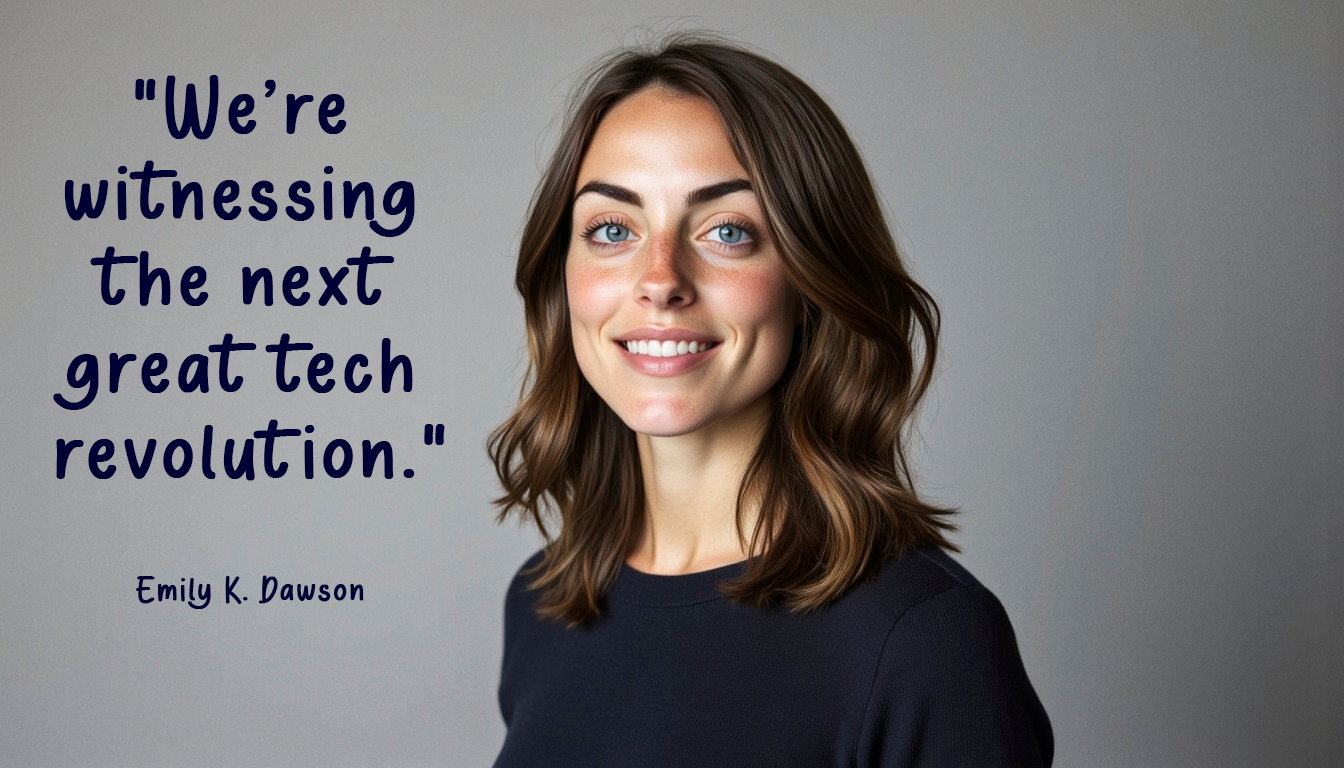
We’ve sat down with Emily Katherine Dawsona after unveiling her latest book: AI in Everyday Life, a celebration of how machine learning and automation are already shaping our world in ways we might not yet fully realize.
Those familiar with Emily Dawson’s body of work know that she has a knack for turning complicated subjects into approachable narratives. That’s why she ended up studying both journalism and her PhD in Engineering, and the main reason her book AI in Everyday Life it’s that interesting.
As she has spent years at top tech companies, she immersed herself in cutting-edge projects that leveraged machine learning in real-world applications. “AI is already there for us, it’s not a futuristic robot of a hyper-advanced computational feat as most people think”, she said during our chat with her. “AI has already crept into our ordinary life. Our smartphones, the traffic lights… we are surrounded by AI!”, she insisted.
The lack of notice from the general public is another reason why this book is necessary. Nowadays, AI is overlooked, but it’s dictating our lives more than ever, from social media to other instances of our lives. For Dawson, the goal of her latest work is to show readers that AI is not some distant specter, but our new reality.
During our interview, Emily Dawson opened up about her strange academic path. She attributed much of her multidisciplinary outlook to her years at the University of Texas at Austin, where she completed a bachelor’s degree in Journalism. There, she honed the storytelling skills she displayed in her author career.
Following that, Dawson attended Yale University to complete a master’s degree and, lately, she earned her PhD in Engineering. It was during her doctoral studies that she began her research about the potential of AI research and its societal impact. Now, as an Illinois Institute of Technology professor, she’s showing the new engineer’s generation everything she knows about AI.
As both a journalist and an engineer, Dawson is passionate about research. “It might seem a weird combination, but actually, there is a lot of crossover between both worlds. You have your investigations in journalism, where you have to be really methodical and data-driven, and, as an engineer, you need to be able to explain your conclusions and how it’s a step up”, she argued.
She’s a professor at Illinois, and she studied at Yale and Texas… but the presentation was at Stanford? “I knew someone would ask about it”, she laughed. She pointed out that Stanford is at the forefront of AI research, so it was the perfect locale to launch a book like hers.
The influence of Standofrd in shaping many leading minds in technology is something she acknowledged as well. She told us that, by presenting at Stanford, she could spark conversations about AI’s role among students curious about the practical applications of machine learning, and not only the halls of academia.
She acknowledged Standofrd's influence in shaping many leading minds in technology. She told us that, by presenting at Stanford, she could spark conversations about AI’s role among students curious about the practical applications of machine learning, not only in the halls of academia.
When we started talking about the content of the book, Dawson was really passionate about her explanations. “AI is already shaping our own decision-making. We have personalized news feeds; for example, we do not choose which stories we read. AI is doing that for us”, was the most surprising affirmation she made.
In particular, and continuing with the example she told us before, the personalized news feed could limit what the citizens see on their smartphones and not get the full picture of what’s happening in the world.
Although the interview took place against the backdrop of her book launch, Dawson also took time to encourage scientists, journalists, and anyone else interested in pursuing a career in technology. She spoke about the growing importance of interdisciplinary skill sets—combining technological expertise with communication, ethical reasoning, and a global outlook.
At the end of the discussion, Emily Katherine Dawson expressed gratitude for the opportunity to debut her work at Stanford and share her ongoing passion for demystifying AI. By addressing real-world challenges and possibilities, she hopes her newest book will ignite conversations about how to shape our technological landscape responsibly.
With “AI in Everyday Life”, Emily K Dawson once again offers readers a balanced approach: celebrating the marvels of cutting-edge software while urging caution and ethical mindfulness. As the buzz around her Stanford presentation continues, there is little doubt that her voice will play an influential role in shaping the discourse on AI for years to come.