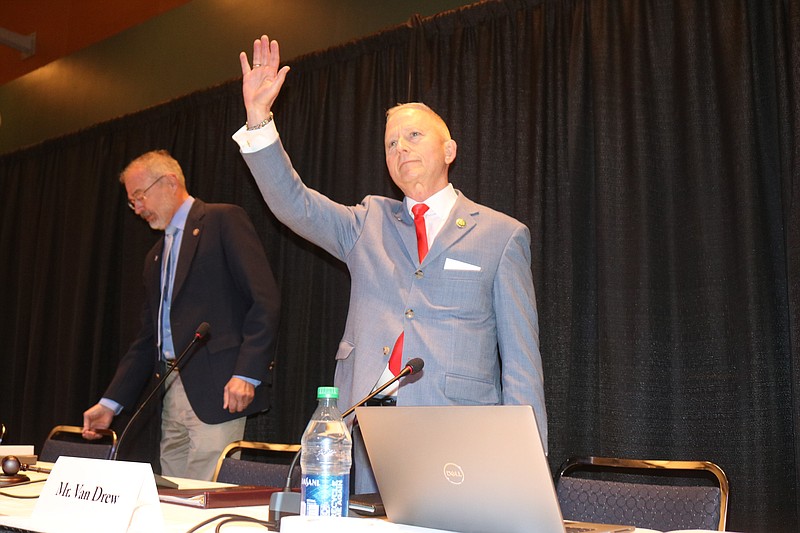
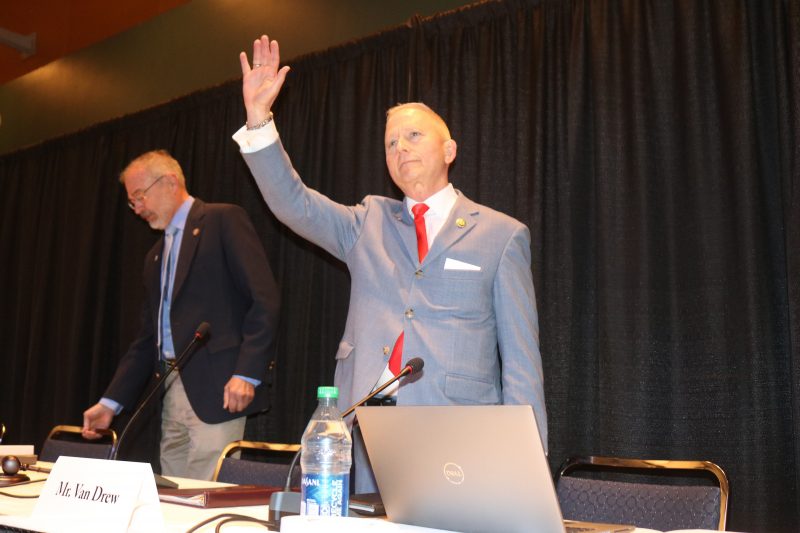
Congressman Jeff Van Drew waves to the audience during a March 16, 2023, congressional hearing on the possible negative impacts of wind farms.
 By DONALD WITTKOWSKI
Four congressmen and a panel of expert witnesses denounced plans for a series of offshore wind energy projects as a mass “industrialization” of the ocean that will cause environmental harm and could seriously damage the Jersey Shore’s tourism industry.
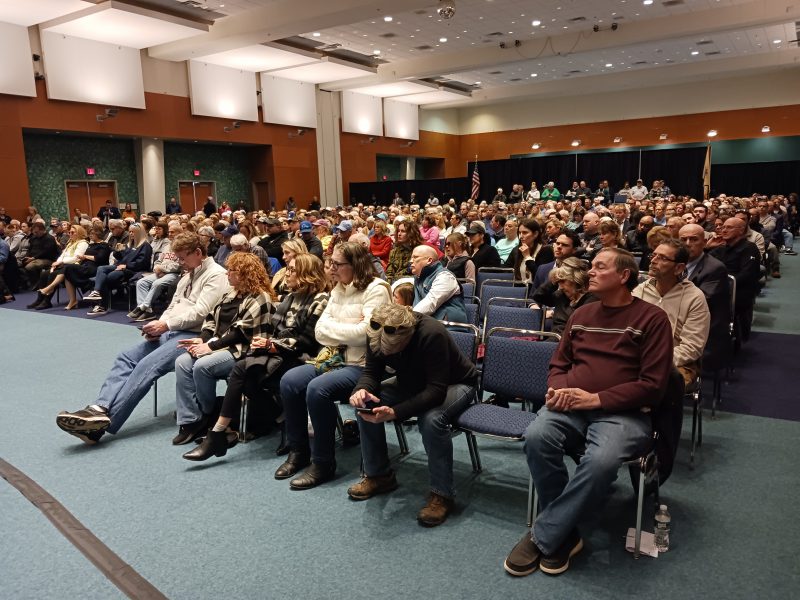
The congressional hearing Thursday at the Wildwoods Convention Center was packed with an overflow crowd of about 450 people, while dozens of others were not allowed to enter the auditorium because of crowd restrictions.
“Let us in. Let us in,” chanted the people who were forced to stand outside while the hearing got underway.
U.S. Rep. Jeff Van Drew, who headed the hearing, vowed that President Joe Biden and Gov. Phil Murphy’s Democratic administrations will face stiff opposition if they continue to support the development of wind farms off New Jersey and other East Coast states.
“This is not the last hearing, I tell you. We are not giving up on this,” said Van Drew, the Republican New Jersey congressman whose district includes the shore communities in Atlantic and Cape May counties.
https://www.youtube.com/watch?v=j9MY7G8pi5M
Video of Congressional hearing of offshore wind projects
U.S. Rep. Chris Smith, another New Jersey Republican congressman, blasted the federal and state regulatory agencies under Biden and Murphy’s control for allegedly ignoring evidence about the possible negative impacts that the wind farms could cause.
“The wind farm approval process has been shoddy at best, leaving unaddressed and unanswered numerous serious questions concerning the extraordinarily harmful environmental impact on marine life and the ecosystems that allow all sea creatures great and small to thrive,” Smith said.
In even stronger comments, Van Drew accused the Danish energy company Orsted, which plans to build a wind farm 15 miles offshore from Atlantic City to Stone Harbor, of misleading the public about the impacts of the project.
“They lied,” Van Drew said, bluntly. He continued, “They don’t even tell the truth. They don’t care.”
The hearing follows the deaths of 29 whales along the East Coast – including nine in New Jersey since early December – that wind farm critics suspect may have been caused by preliminary surveying work of the seabed for the offshore projects.
However, the National Oceanic and Atmospheric Administration, the New Jersey Department of Environmental Protection and the Marine Mammal Stranding Center in Brigantine are among the government agencies or organizations that dispute any connection between the wind farms and the dead whales.
“As of March 2023, no offshore wind-related construction activities have taken place in waters off the New Jersey coast, and DEP is aware of no credible evidence that offshore wind-related survey activities could cause whale mortality,” the DEP said in a statement this week.
NOAA and the Marine Mammal Stranding Center have concluded that most of the whale deaths were caused by vessel strikes after examining the carcasses and finding the types of injuries consistent with collisions with ships.
By DONALD WITTKOWSKI
Four congressmen and a panel of expert witnesses denounced plans for a series of offshore wind energy projects as a mass “industrialization” of the ocean that will cause environmental harm and could seriously damage the Jersey Shore’s tourism industry.
The congressional hearing Thursday at the Wildwoods Convention Center was packed with an overflow crowd of about 450 people, while dozens of others were not allowed to enter the auditorium because of crowd restrictions.
“Let us in. Let us in,” chanted the people who were forced to stand outside while the hearing got underway.
U.S. Rep. Jeff Van Drew, who headed the hearing, vowed that President Joe Biden and Gov. Phil Murphy’s Democratic administrations will face stiff opposition if they continue to support the development of wind farms off New Jersey and other East Coast states.
“This is not the last hearing, I tell you. We are not giving up on this,” said Van Drew, the Republican New Jersey congressman whose district includes the shore communities in Atlantic and Cape May counties.
https://www.youtube.com/watch?v=j9MY7G8pi5M
Video of Congressional hearing of offshore wind projects
U.S. Rep. Chris Smith, another New Jersey Republican congressman, blasted the federal and state regulatory agencies under Biden and Murphy’s control for allegedly ignoring evidence about the possible negative impacts that the wind farms could cause.
“The wind farm approval process has been shoddy at best, leaving unaddressed and unanswered numerous serious questions concerning the extraordinarily harmful environmental impact on marine life and the ecosystems that allow all sea creatures great and small to thrive,” Smith said.
In even stronger comments, Van Drew accused the Danish energy company Orsted, which plans to build a wind farm 15 miles offshore from Atlantic City to Stone Harbor, of misleading the public about the impacts of the project.
“They lied,” Van Drew said, bluntly. He continued, “They don’t even tell the truth. They don’t care.”
The hearing follows the deaths of 29 whales along the East Coast – including nine in New Jersey since early December – that wind farm critics suspect may have been caused by preliminary surveying work of the seabed for the offshore projects.
However, the National Oceanic and Atmospheric Administration, the New Jersey Department of Environmental Protection and the Marine Mammal Stranding Center in Brigantine are among the government agencies or organizations that dispute any connection between the wind farms and the dead whales.
“As of March 2023, no offshore wind-related construction activities have taken place in waters off the New Jersey coast, and DEP is aware of no credible evidence that offshore wind-related survey activities could cause whale mortality,” the DEP said in a statement this week.
NOAA and the Marine Mammal Stranding Center have concluded that most of the whale deaths were caused by vessel strikes after examining the carcasses and finding the types of injuries consistent with collisions with ships.
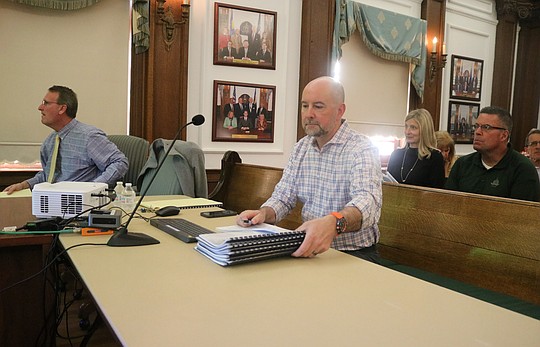
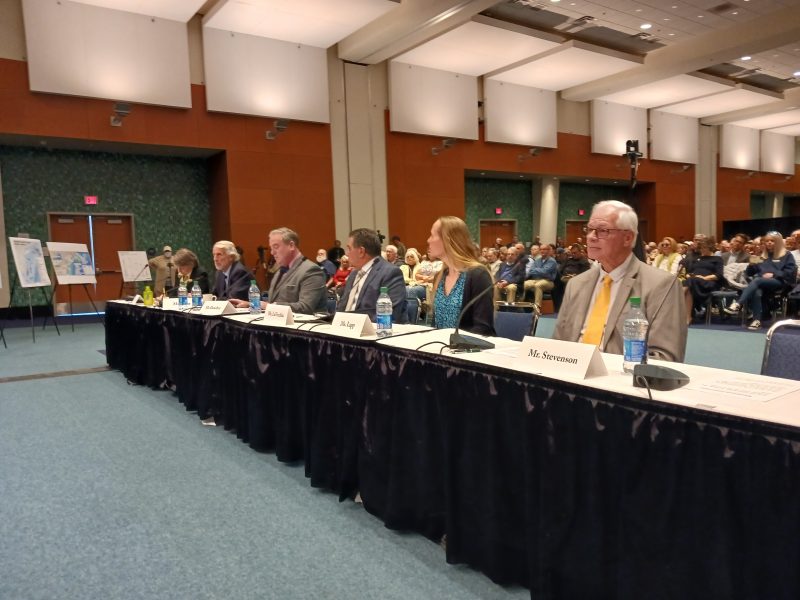 Testimony is heard from a panel of expert witnesses.
One witness, Michael Donohue, an attorney who is representing Cape May County in its legal fight against Orsted’s proposed wind farm, warned of the possible negative impacts of the project on tourism at the Jersey Shore.
Donohue said the impact on Cape May County’s nearly $7 billion per year tourism industry could be “devastating.” Citing statistics from the Cape May County Department of Tourism, Donohue said tourism could fall 15 percent across the board, resulting in a $993 million decline in tourism spending.
“A decline of 15 percent would be devastating to our economy,” he said.
“We live and thrive on tourism,” Donohue added. “It’s the lifeblood of our economy. We survive only because of tourism.”
Other witnesses focused on the possible harmful impacts of the wind farms on the environment, marine life, the commercial fishing industry and the cost of electricity.
Cindy Zipf, executive director of the environmental group Clean Ocean Action, predicted that wind farms would lead to the mass industrialization of the ocean.
“We are creating a vast power plant in the ocean, which will have catastrophic impacts,” Zipf said.
Bob Stern, former director of the Office of Environmental Compliance at the U.S. Department of Energy, testified that there have been an unusually high number of whale deaths in New Jersey since December.
So far, nine dead whales have washed up on New Jersey beaches in the last three months, compared to an annual average of seven deaths, he said.
Stern said “it doesn’t take a rocket scientist” to figure out that the whale deaths could be caused by preliminary work on the wind farms.
Testimony is heard from a panel of expert witnesses.
One witness, Michael Donohue, an attorney who is representing Cape May County in its legal fight against Orsted’s proposed wind farm, warned of the possible negative impacts of the project on tourism at the Jersey Shore.
Donohue said the impact on Cape May County’s nearly $7 billion per year tourism industry could be “devastating.” Citing statistics from the Cape May County Department of Tourism, Donohue said tourism could fall 15 percent across the board, resulting in a $993 million decline in tourism spending.
“A decline of 15 percent would be devastating to our economy,” he said.
“We live and thrive on tourism,” Donohue added. “It’s the lifeblood of our economy. We survive only because of tourism.”
Other witnesses focused on the possible harmful impacts of the wind farms on the environment, marine life, the commercial fishing industry and the cost of electricity.
Cindy Zipf, executive director of the environmental group Clean Ocean Action, predicted that wind farms would lead to the mass industrialization of the ocean.
“We are creating a vast power plant in the ocean, which will have catastrophic impacts,” Zipf said.
Bob Stern, former director of the Office of Environmental Compliance at the U.S. Department of Energy, testified that there have been an unusually high number of whale deaths in New Jersey since December.
So far, nine dead whales have washed up on New Jersey beaches in the last three months, compared to an annual average of seven deaths, he said.
Stern said “it doesn’t take a rocket scientist” to figure out that the whale deaths could be caused by preliminary work on the wind farms.
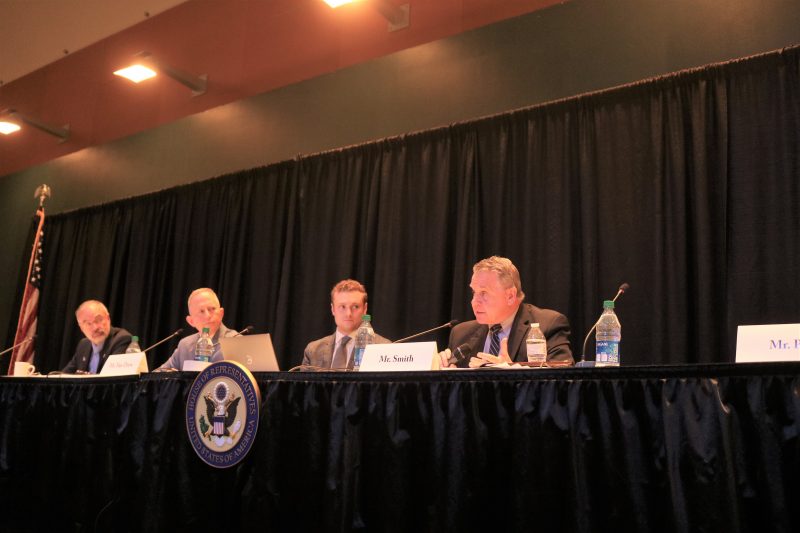 Seated at right, U.S. Rep. Chris Smith of New Jersey speaks to the audience.
Stern also warned of the aesthetic drawbacks of having nearly 100 towering wind turbines located 15 miles off the coast as part of the Orsted project.
“We’re looking at this as the destruction of the shore experience,” said Stern, who is also part of Save Long Beach Island, a grassroots group in Ocean County that is raising public awareness about wind farms.
Two representatives of the seafood and commercial fishing industries testified that the wind farms could greatly harm their operations. They said fishing boats would have to find new fishing grounds and would also have to travel farther distances to avoid the offshore wind turbines.
The result could be higher seafood prices, food shortages and job cuts because of the extra demands placed on their industries, they said.
Offshore wind projects are the “single greatest threat” to commercial fishing operations, said Meghan Lapp, liaison to Seafreeze, the largest trader of frozen seafood on the East Coast.
In yet more criticism leveled at the wind farm projects, another witness predicted that electric bills will increase if offshore wind is developed in New Jersey.
Gov. Murphy, a strong supporter of offshore wind technology, wants New Jersey to become a leader in green energy. So far, New Jersey has approved three offshore wind farms and is looking to add more. Murphy’s goal is to have offshore wind farms producing 11,000 megawatts of power in New Jersey by 2040.
David Stevenson, director of the Center for Energy and Policy at the Caesar Rodney Institute, testified at the hearing that electric bills will rise an estimated $100 each year for New Jersey households that have their power supplied by offshore wind projects.
Taking a long-term perspective, Stevenson said that would equate to a $2,000 increase in annual electricity bills for New Jersey households after 20 years of offshore wind power.
Seated at right, U.S. Rep. Chris Smith of New Jersey speaks to the audience.
Stern also warned of the aesthetic drawbacks of having nearly 100 towering wind turbines located 15 miles off the coast as part of the Orsted project.
“We’re looking at this as the destruction of the shore experience,” said Stern, who is also part of Save Long Beach Island, a grassroots group in Ocean County that is raising public awareness about wind farms.
Two representatives of the seafood and commercial fishing industries testified that the wind farms could greatly harm their operations. They said fishing boats would have to find new fishing grounds and would also have to travel farther distances to avoid the offshore wind turbines.
The result could be higher seafood prices, food shortages and job cuts because of the extra demands placed on their industries, they said.
Offshore wind projects are the “single greatest threat” to commercial fishing operations, said Meghan Lapp, liaison to Seafreeze, the largest trader of frozen seafood on the East Coast.
In yet more criticism leveled at the wind farm projects, another witness predicted that electric bills will increase if offshore wind is developed in New Jersey.
Gov. Murphy, a strong supporter of offshore wind technology, wants New Jersey to become a leader in green energy. So far, New Jersey has approved three offshore wind farms and is looking to add more. Murphy’s goal is to have offshore wind farms producing 11,000 megawatts of power in New Jersey by 2040.
David Stevenson, director of the Center for Energy and Policy at the Caesar Rodney Institute, testified at the hearing that electric bills will rise an estimated $100 each year for New Jersey households that have their power supplied by offshore wind projects.
Taking a long-term perspective, Stevenson said that would equate to a $2,000 increase in annual electricity bills for New Jersey households after 20 years of offshore wind power.
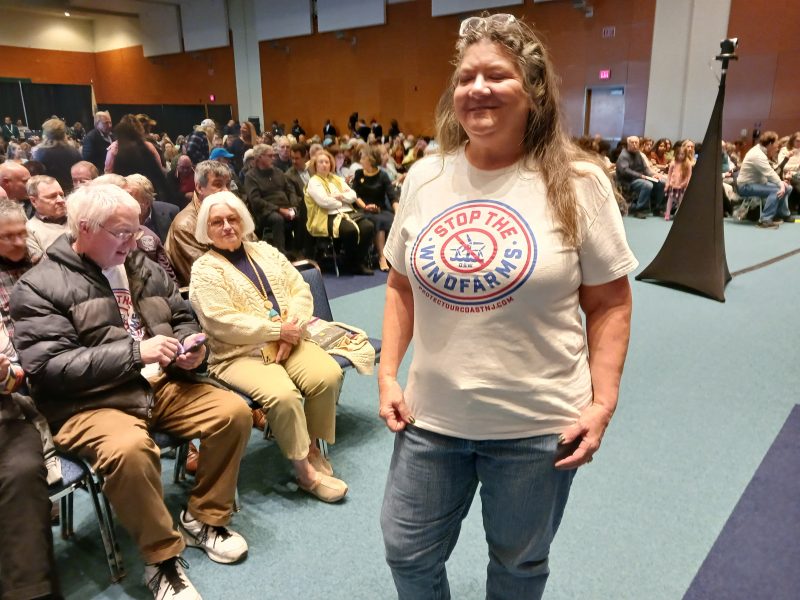 Ocean City resident Suzanne Hornick, of the group Protect Our Coast NJ, wears a T-shirt in opposition to offshore wind projects.