
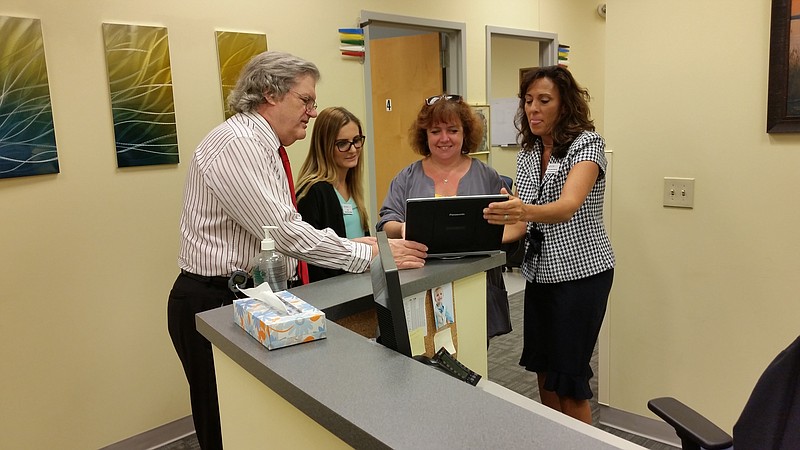
Dr. Roeltgen consults with staff members at the facility. More employees are expected to be added in about six months.
 By Donald Wittkowski
The Aug. 8 death of country music star Glen Campbell from Alzheimer’s disease showed once again that the devastating, memory-robbing disorder doesn’t discriminate.
It can kill celebrities just as easily as it does scores of ordinary people, stressed Dr. David Roeltgen, a neurologist who has been treating the disease for 35 years.
“Ronald Reagan, that’s about as well-known an Alzheimer’s patient as there is,” Roeltgen noted.
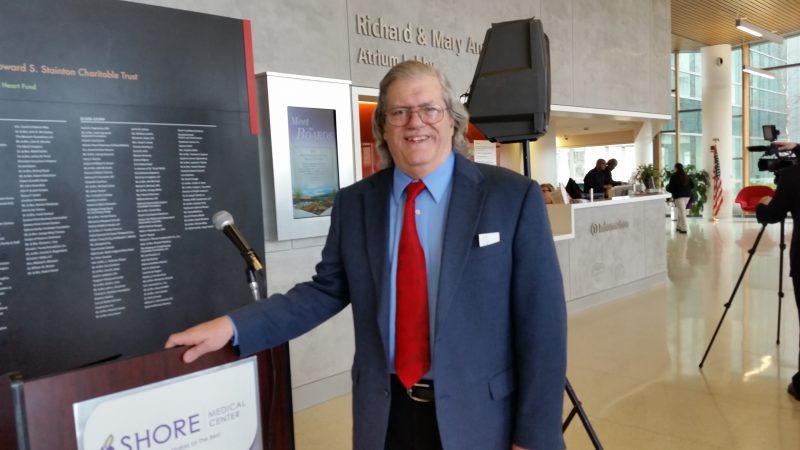
The 67-year-old Roeltgen doesn’t believe that a cure will be found during his lifetime, but he is determined to fight the disease nonetheless as the director of a new treatment and research center devoted to Alzheimer’s patients and their families.
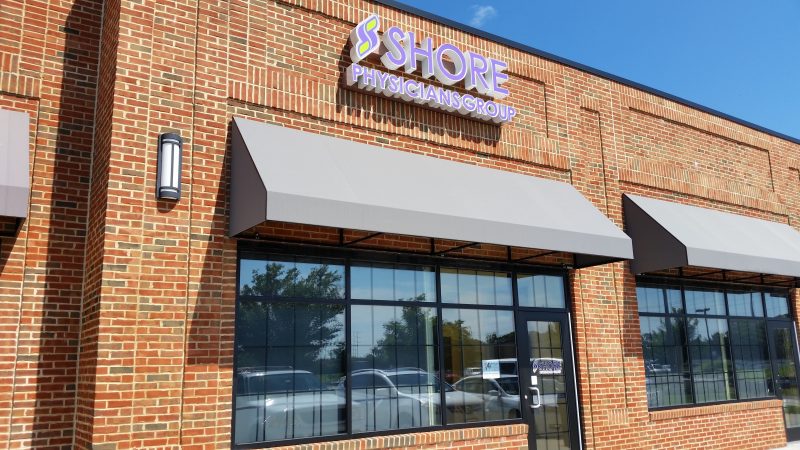
The Flora Baker Alzheimer’s Disease and Related Disorders Center opened July 25 in a Shore Physicians Group office next to the ShopRite supermarket off Route 9 in Marmora.
By Donald Wittkowski
The Aug. 8 death of country music star Glen Campbell from Alzheimer’s disease showed once again that the devastating, memory-robbing disorder doesn’t discriminate.
It can kill celebrities just as easily as it does scores of ordinary people, stressed Dr. David Roeltgen, a neurologist who has been treating the disease for 35 years.
“Ronald Reagan, that’s about as well-known an Alzheimer’s patient as there is,” Roeltgen noted.
The 67-year-old Roeltgen doesn’t believe that a cure will be found during his lifetime, but he is determined to fight the disease nonetheless as the director of a new treatment and research center devoted to Alzheimer’s patients and their families.
The Flora Baker Alzheimer’s Disease and Related Disorders Center opened July 25 in a Shore Physicians Group office next to the ShopRite supermarket off Route 9 in Marmora.
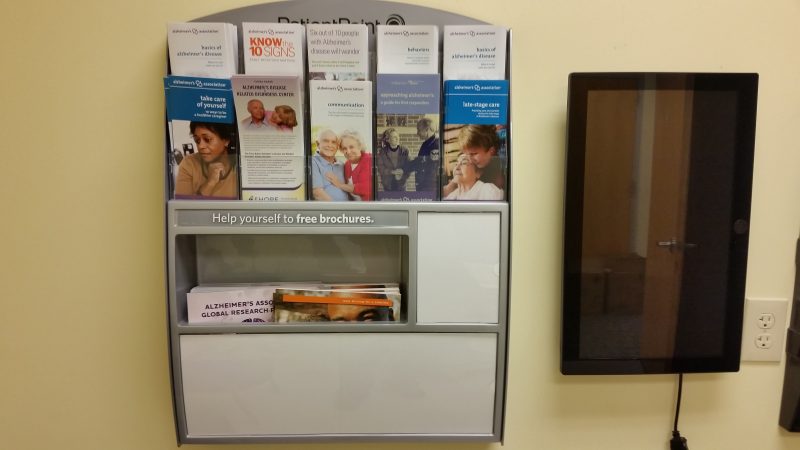 Pamphlets available at the Alzheimer's center provide information on the brain disorder.
The Alzheimer’s Association says more than 5 million Americans are living with the disease. Even grimmer, the figure could rise as high as 16 million Americans by 2050, the association estimates. Currently, one in three senior citizens in the United States dies of Alzheimer’s or another form of dementia, according to the association.
Hoping to boost the quality of life for Alzheimer’s patients, the new center provides a streamlined approach toward the diagnosis and treatment of the disease. Patients will benefit from a “continuum of care” involving doctors, family members and professional caregivers.
The facility will offer treatment for patients, support for their families and clinical trials of experimental drugs to combat Alzheimer’s.
“Every aspect of their life – the patient, the spouse and the caregiver – is affected by the disease,” Roeltgen said. “We’re talking about a life-changing problem.”
Roeltgen estimated the Alzheimer’s center will see an average of five new patients each week.
The facility was funded by a $500,000 donation from the Ocean City Masonic Lodge No. 171 through an endowment for Alzheimer’s treatment established by the now-deceased Flora Baker, a local businesswoman. Baker set up the endowment in honor of her late husband, Benjamin, who was a member of the Ocean City Masons.
Currently, the center’s staff includes Roeltgen, a medical assistant, a social worker and a patient-family educator. Over the next six months, Roeltgen envisions adding a geriatric psychiatrist, a neuropsychologist and a clinician.
Pamphlets available at the Alzheimer's center provide information on the brain disorder.
The Alzheimer’s Association says more than 5 million Americans are living with the disease. Even grimmer, the figure could rise as high as 16 million Americans by 2050, the association estimates. Currently, one in three senior citizens in the United States dies of Alzheimer’s or another form of dementia, according to the association.
Hoping to boost the quality of life for Alzheimer’s patients, the new center provides a streamlined approach toward the diagnosis and treatment of the disease. Patients will benefit from a “continuum of care” involving doctors, family members and professional caregivers.
The facility will offer treatment for patients, support for their families and clinical trials of experimental drugs to combat Alzheimer’s.
“Every aspect of their life – the patient, the spouse and the caregiver – is affected by the disease,” Roeltgen said. “We’re talking about a life-changing problem.”
Roeltgen estimated the Alzheimer’s center will see an average of five new patients each week.
The facility was funded by a $500,000 donation from the Ocean City Masonic Lodge No. 171 through an endowment for Alzheimer’s treatment established by the now-deceased Flora Baker, a local businesswoman. Baker set up the endowment in honor of her late husband, Benjamin, who was a member of the Ocean City Masons.
Currently, the center’s staff includes Roeltgen, a medical assistant, a social worker and a patient-family educator. Over the next six months, Roeltgen envisions adding a geriatric psychiatrist, a neuropsychologist and a clinician.
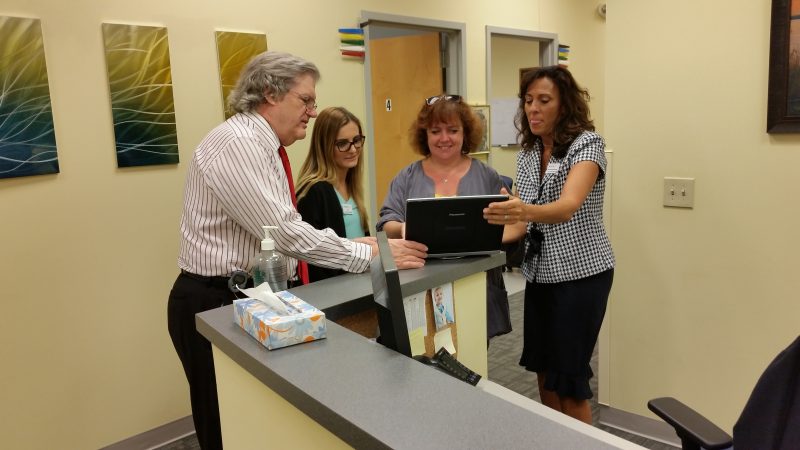 Dr. Roeltgen consults with staff members at the facility. More employees are expected to be added in about six months.
Talks are underway between the Alzheimer’s center and Johns Hopkins Medicine, the acclaimed hospital and healthcare system based in Baltimore, about working together on a program to boost the quality of life for patients and minimize stress for their caregivers, Roeltgen said.
The program will look for ways to keep Alzheimer’s patients out of the hospital and delay them from being placed in nursing homes, both key factors in the management of the disease and reducing medical costs, according to Roeltgen.
Despite extraordinary breakthroughs in medicine overall, the cause of Alzheimer’s disease and the cure have thus far eluded the medical world. Roeltgen said that 10 years ago, he was optimistic that a cure would be discovered within his lifetime. But now, he doesn’t believe it will happen in his lifetime.
“We don’t know. That’s the thing,” he said bluntly.
A series of Alzheimer’s studies are expected to be published around 2020, fueling speculation among optimists that a cure may be around the corner. But Roeltgen isn’t as confident.
“It’s far, far more complicated than what we think,” he said.
Dr. Roeltgen consults with staff members at the facility. More employees are expected to be added in about six months.
Talks are underway between the Alzheimer’s center and Johns Hopkins Medicine, the acclaimed hospital and healthcare system based in Baltimore, about working together on a program to boost the quality of life for patients and minimize stress for their caregivers, Roeltgen said.
The program will look for ways to keep Alzheimer’s patients out of the hospital and delay them from being placed in nursing homes, both key factors in the management of the disease and reducing medical costs, according to Roeltgen.
Despite extraordinary breakthroughs in medicine overall, the cause of Alzheimer’s disease and the cure have thus far eluded the medical world. Roeltgen said that 10 years ago, he was optimistic that a cure would be discovered within his lifetime. But now, he doesn’t believe it will happen in his lifetime.
“We don’t know. That’s the thing,” he said bluntly.
A series of Alzheimer’s studies are expected to be published around 2020, fueling speculation among optimists that a cure may be around the corner. But Roeltgen isn’t as confident.
“It’s far, far more complicated than what we think,” he said.






